



Lightweighting Engineering: Reducing Jewelry Metal Weight Without Losing Perceived Value
Jump to: 1. Why Lightweighting Is an Engineering Decision · 2. Where Weight Actually Lives · 3. Three Structural Routes · 4. Wall Thickness, Ribs and Load Paths · 5. Four Re-Validations · 6. When Not to Lighten · 7. Tech Pack Requirements · 8. FAQ
When gold and silver stay expensive, the fastest way to lower a piece’s material cost is to take metal out of it. The most expensive way is to take out the wrong metal, and only find out after three months of wear, a batch of customer returns, or a stone that will not stay seated.
Lightweighting is not a costing exercise applied to a finished design. It is a structural decision that has to be made before tooling, documented in the Tech Pack, and verified on the first article. As the market analysis in our sales value versus sales volume review shows, buyers are absorbing higher metal prices while still expecting a piece to feel substantial. Those two pressures meet exactly at the wall section.
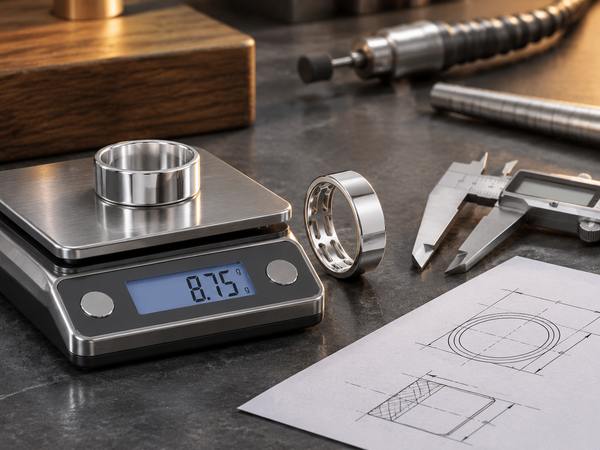
Figure 1: Grams are measurable on a scale. Perceived value is not — it is the sum of edge thickness, rigidity and surface quality.
1. Why Lightweighting Is an Engineering Decision
Metal cost scales with grams. Labor, finishing, setting, inspection and packaging scale with pieces. When you remove metal, the material share of the unit cost falls while the per-piece processing cost stays roughly where it was — so the net saving is rarely proportional to the grams removed.
That is the first thing to settle with a buyer. In a high metal price environment, a piece that drops a meaningful share of its weight but keeps a deep polish, a hand-finished interior and a tight setting may return a much smaller cost reduction than expected. The trade is only worth making when the removed metal does not also remove the reasons someone pays for the piece.
Buyers do not weigh a ring. They judge it through four signals that correlate with mass but are not identical to it:
- Edge and contact thickness — the band edge, the bail wall, the rim of a dome. These are the surfaces a thumb actually reads.
- Rigidity in the hand — whether the piece flexes or deforms when squeezed, sat on, or dropped on a hard floor.
- Surface integrity — whether a deep polish, oxidation contrast or stone setting survives handling at retail.
- Assembly security — prongs, hinge, solder joints and clasps, which are the first things to fail on a lightened piece.
The engineering objective is therefore not “lowest weight”. It is the lowest mass that still passes all four, at the target price point and the target service life.
2. Where Weight Actually Lives in a Piece
Weight reduction fails most often because it is applied globally — the whole model is scaled down by a percentage — instead of locally, at the zone that actually carries mass. The first step of any lightweighting review is to identify that zone, and to identify the zones that must not be touched.
| Piece Type | Where the Mass Sits | Lightening Leverage | Do Not Touch |
|---|---|---|---|
| Wide band ring | Shank cross-section and shoulder mass | Internal coring of the shank, underside relief | Sizing area, prong roots, comfort-fit radius |
| Pendant | Back plate thickness, bail | Recessed back, hollow dome, open reverse | Bail wall, jump ring, solder joints |
| Hoop earring | Tube wall thickness | Hollow tube instead of solid rod | Hinge, post, latch seat |
| Chain | Link gauge and link diameter | Gauge reduction, hollow link construction | Clasp, end caps, soldered connections |
3. Three Structural Routes — and Where Each One Fails
Almost every lightweighting proposal resolves into one of three structures. They are not interchangeable, and each one has a characteristic failure mode that shows up downstream rather than at the sample stage.
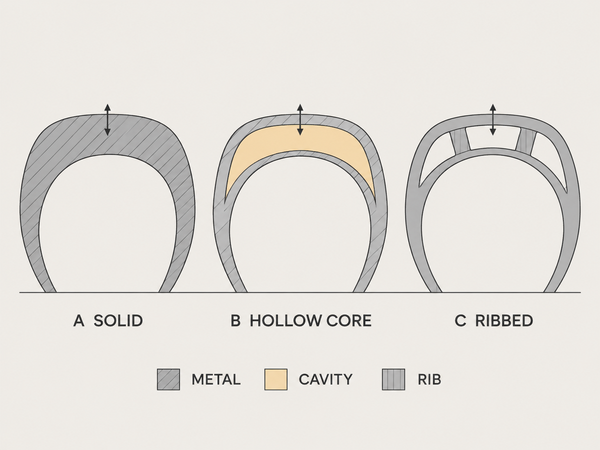
Figure 2: Three ways to remove metal from the same outer form: solid section, internal hollow core, and a ribbed underside.
A. Internal Coring in Casting
Metal is removed from a cavity inside the casting that no one sees: the shank interior, the back of a pendant, the body of a sculptural element. The silhouette stays identical and the piece still reads as a solid casting from every normal viewing angle.
Where it fails: the core needs access and support, the wall must still fill completely at the casting stage, and the transition from thick to thin section is where shrinkage porosity appears. Interior surfaces are also hard to polish and plate evenly, so a cored ring can develop a rough inner face that the customer feels before they see anything.
B. Hollow Electroforming and Hollow Tube Construction
A thin shell is deposited on a mandrel or formed from tube, producing the largest weight reduction per unit of visible volume. This is the route behind most hollow hoops, hollow bangles and large-volume pendants.
Where it fails: wall uniformity, dent resistance, and repairability. A hollow hoop that is dropped on tile can deform permanently; a hollow shank cannot be sized down or up the way a solid one can. Plating throw into the interior and solder joints at the shell edge need explicit process control, not assumption.
C. Underside Relief and Webbing
Metal is removed only from the non-contact underside, and short ribs or a webbing pattern are left behind to carry the load. From the top, nothing changes; from the finger side, the piece looks engineered rather than hollowed out.
Where it fails: ribs that are too thin do not survive polishing, and aggressive relief on a cast surface can pull a sink mark onto the show face. Rib roots need radii and draft, and the layout has to follow the load path rather than a decorative grid.
4. Wall Thickness, Ribs and Load Paths
Uniform thinning is the most common mistake in weight reduction, because stiffness does not fall linearly with wall thickness. Bending stiffness scales with the cube of the wall: halve the wall and you keep half the mass but roughly one eighth of the stiffness. That is why a band that is 50% lighter and 50% thinner does not feel “a bit lighter”. It feels like a different, cheaper object.
Ribs exist to break that relationship. A rib placed along the load path restores most of the rigidity at a fraction of the mass that thickening the whole surface would require. Three conditions make ribs work in production:
- The rib follows the direction the piece actually bends or is compressed, not a symmetrical decorative pattern;
- The root is radiused and drafted, so the casting fills and the mold releases without a stress riser;
- The rib is not placed directly beneath a high-polish show surface without sink-mark control, or the polish will reveal it as a shadow line.
Minimum wall is not a universal number. It is set by alloy, casting method, section length and the polishing process that follows, and it has to be confirmed on a trial casting rather than assumed from a table. This is the same principle we apply in the pre-tooling CAD review: the number that matters is the one the process can hold repeatedly.
5. Four Re-Validations After Any Weight Reduction
Once a design is lightened, the original approval is no longer valid. Four checks have to be repeated on the revised first article, and all four have to pass before the mold is released to production.
- Deformation under wear load. Squeeze the band, drop it on a hard surface, load the bail. Compare against the approved original, not against a drawing.
- Dent and crush resistance. Critical for hollow and cored structures. Define the acceptable service life with the buyer — a hollow piece that is expected to survive daily wear for years is a different specification from one sold as occasional fashion.
- Stone seat and assembly integrity. Prong roots, bezel walls, hinge seats and solder joints are where lightened pieces fail first. Re-tighten and re-inspect after finishing, not only after setting.
- Finishing and plating coverage. Lighter sections polish faster and can be over-buffed; recessed interiors plate unevenly; oxidation contrast behaves differently on a ribbed surface than on a flat one. Check coverage on a cross-section, not only on the face.
Two production documents should be updated at the same time: the weight tolerance against the approved sample, and the casting yield expectation. A design that saves metal but raises scrap rate has not saved anything. The consistency controls in our sample-to-mass-production guide apply unchanged to a lightened piece — in fact they matter more, because there is less material absorbing the variation.
6. When Not to Lighten
There are categories where removing grams is the wrong decision, regardless of how attractive the material saving looks on paper:
- Gram-value buyers. Customers who buy precious metal as stored value check the weight, and a lighter piece reads as a worse purchase even at a lower price.
- Wide men’s bands and heavy signet styles. Here heft is the product. A wide band that has been cored feels like a costume piece in the hand.
- Pieces likely to be resized. Hollow and heavily cored shanks resize poorly or not at all, which turns a sizing request into a remake.
- Thin chains and small findings. The strength margin is already small; reducing gauge converts a wear item into a return.
- Openwork and reversible designs. If the interior is visible, hollowing stops being invisible and becomes a visible cost decision.
The material decision sits upstream of all of this. If a collection can move from solid gold to 925 sterling silver, or from a heavy casting to a well-engineered hollow structure, that choice belongs in the metal selection stage, not in a last-minute cost negotiation after the mold exists. Our earlier analysis of how rising silver prices change manufacturing decisions makes the same point from the cost side.
7. Writing Lightweighting Requirements into the Tech Pack
“Make it lighter” is not a specification. A manufacturer can only engineer against numbers attached to locations. A workable lightweighting brief contains seven items:
- Target weight per size, expressed as a range rather than a single figure, with the approved reference sample named.
- Minimum wall thickness by named zone — shank bottom, shoulder, bail, bezel wall — not one global value.
- No-go zones that must remain at original thickness: sizing area, prong roots, hinge and spring seats, clasp attachment.
- Permitted removal method: internal coring, hollow construction or underside relief, so the factory does not choose a cheaper route with a different failure mode.
- Section drawings through the lightened area, because a rendered view will not show a cored interior or a rib layout.
- First-article tests: weight against target, crush or drop test, stone security check after finishing.
- Weight tolerance for repeat orders, so the second production run is compared against a defined band rather than against memory.
These seven items map directly onto the sections of a standard jewelry Tech Pack. Adding a weight section costs one page and prevents the most common lightweighting outcome: a sample that looks right, weighs right, and fails in the field.
Frequently Asked Questions
Q1: Can an existing design be lightened without new tooling?
Sometimes, but not usually. Underside relief can occasionally be added by revising the CAD and cutting a new master, while internal coring normally changes the mold construction and the wax tooling. The honest answer depends on how the original was built, which is why we review the CAD and the existing mold before quoting a weight-reduction revision.
Q2: Does a lighter piece always cost less?
No. Material cost falls, but finishing, setting, inspection and scrap rate can rise, and hollow or ribbed structures often need extra process control. The net saving is usually smaller than the gram reduction suggests, and it should be quoted as a revised unit cost rather than promised as a percentage.
Q3: Will a hollow ring dent?
A hollow structure is more susceptible to local deformation than a solid one, and the risk depends on wall thickness, rib support and how the piece is worn. If the target market expects daily wear over years, we generally recommend a ribbed or cored structure over a thin hollow shell, and we define the expected service condition with the buyer before tooling.
Q4: How do you keep a light ring feeling substantial?
By protecting the surfaces the hand reads: keeping edge thickness at the band rim, maintaining curvature across the top face, finishing the interior properly, and using a comfort-fit profile. A piece can lose mass in the hidden underside while keeping the tactile signals that make it feel like a quality object.
Planning a Lighter Collection Without Losing the Feel?
Weight reduction is a structural decision that has to be engineered before the mold is cut, verified on the first article, and documented for repeat orders. AIU Jewelry works with brands and designers on CAD-level lightweighting reviews, hollow and ribbed structure development, and production validation for precious metal collections.
Send your 3D CAD files, target weight per size, or an existing sample you want reviewed, and our engineering team will return a structural assessment covering removal options, wall and rib strategy, and the validation steps required before tooling.
Email: aiu@aiujewelry.com
WhatsApp: +86 137 1283 2025
 anya907888
