



How Rising Silver Prices Change Jewelry Manufacturing Decisions
How Rising Silver Prices Change Jewelry Manufacturing Decisions
Rising silver prices are changing jewelry manufacturing decisions beyond the metal line on a quote. A higher material value magnifies the commercial effect of unclear target weight, avoidable rework, scrap, and batch-to-batch variation. This guide does not predict prices; it explains how buyers can make specifications and supplier comparisons more reliable.
Key takeaways
- Higher silver values amplify weight variance. An undefined target can move both quotation and production cost.
- Lightweight design is not blanket thinning. Material should be redistributed with structure, wear and casting in mind.
- Finished weight needs a measurement scope. State whether stones, chains, findings and tags are included.
- Rework and scrap belong in the cost conversation. Comparing only silver price and labor misses important variance.
- Repeatability matters on reorders. Approved versions, weight ranges and change control should remain traceable.
Why Rising Silver Prices Matter to Manufacturing Decisions
The World Bank September 2026 Pink Sheet reports a silver monthly average of US$65.4 per troy ounce in August 2026, up from US$58.8 in July 2026; the 2025 annual average was US$39.8. These are nominal US-dollar market averages, not a factory purchase price, a futures quote, or the cost of 925 alloy in a finished product. A factory quote can also reflect timing, currency, alloy input, process assumptions and commercial terms.
The limited manufacturing conclusion is that when metal carries more value, the same gram-level difference has a larger cost effect. This data establishes neither order-flow trends nor a future price direction, and it says nothing about a change in physical waste rates. The World Silver Survey 2026 also notes that “fabrication losses were also notable in jewelry and silverware.” This supports asking where metal is accounted for, but it is not a universal factory loss rate.

Silver Jewelry Cost Control: Where Variance Begins
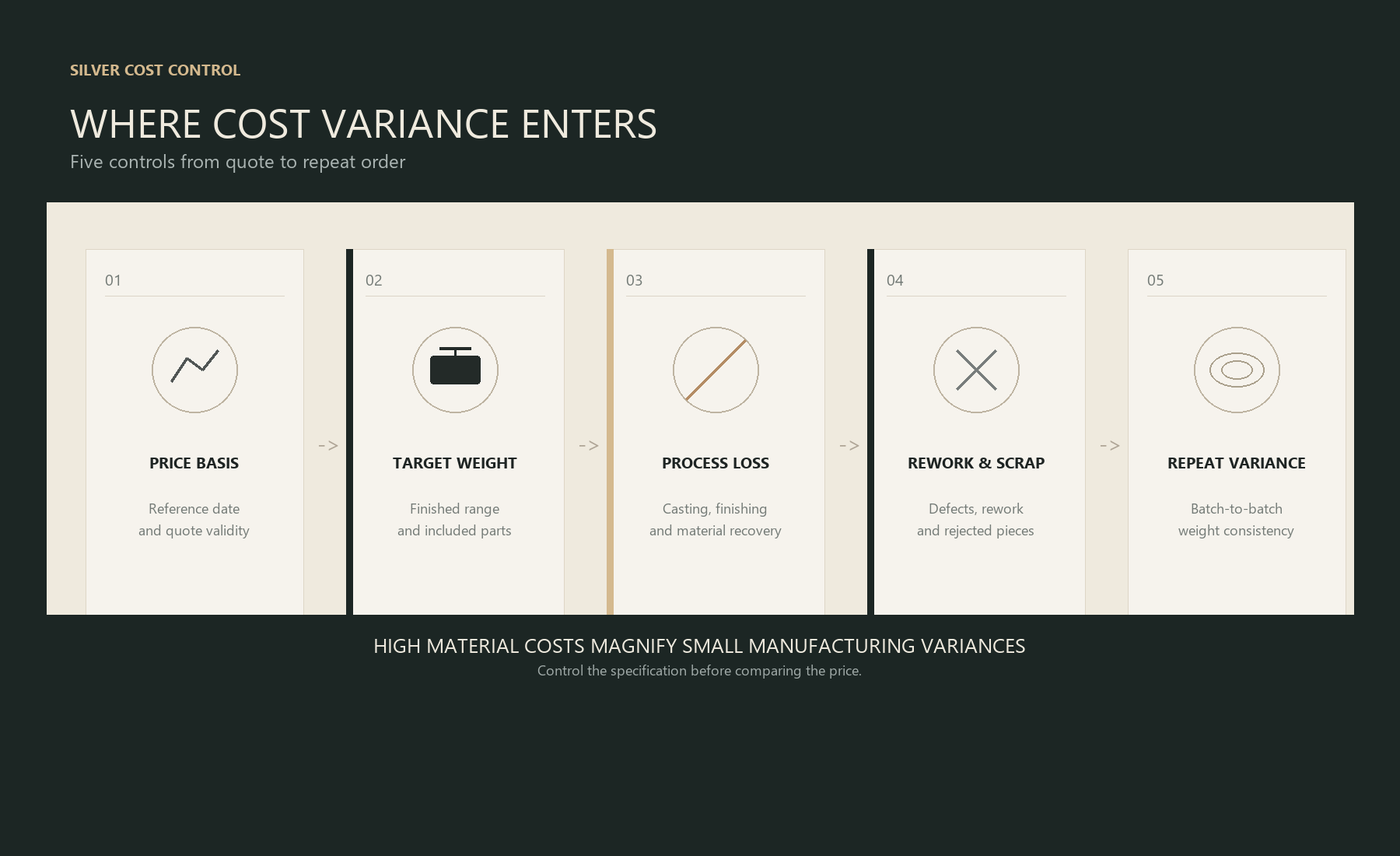
Cost variance can be created before the first production piece is cast. Buyers should separate four mechanisms rather than treating “silver cost” as one number.
- CAD material distribution. Internal geometry, relief depth, hidden cavities and balance determine the calculated volume. Two designs with the same outside dimensions may not share the same metal weight.
- Casting system and recovery assumptions. Feeders, sprues, finishing allowances and recoverable return metal affect how a supplier builds its costing model. Ask what is included instead of assuming every quotation uses the same method.
- Finishing and rework. Polishing changes net weight, while failed castings, corrective work and remakes create costs even if a portion of metal is recovered. Do not infer that the physical loss rate rises merely because market prices rise.
- Version drift. A sample may be approved after several CAD or hand-finishing changes. If the approved version and weight basis are not recorded, a reorder can be priced or made against a different reference.
For plated pieces, weight control and coating specification are separate variables. The plating thickness guide explains why a coating requirement should not be treated as an informal substitute for structural metal decisions.
Sterling Silver Weight Control Without Blanket Thinning
Lightweighting should start with function. Remove or redistribute material in non-load-bearing areas, while protecting connection points, stone seats, closures, edges and surfaces that take wear. Cavities, openwork, linear structures and visual volume can reduce unnecessary mass, but each approach changes casting, cleaning, polishing and assembly access.
This article intentionally stops at principles. There is no universal wall dimension or promised reduction percentage that is safe across rings, pendants, earrings and chains. A jewelry DFM review should examine the particular geometry, wear mode and finishing route before tooling. Buyers can review AIU’s custom construction capabilities; 925 Sterling Silver is an established core line, but every design still needs project-specific evaluation.
Jewelry DFM: Eight Tech Pack Fields That Control Weight
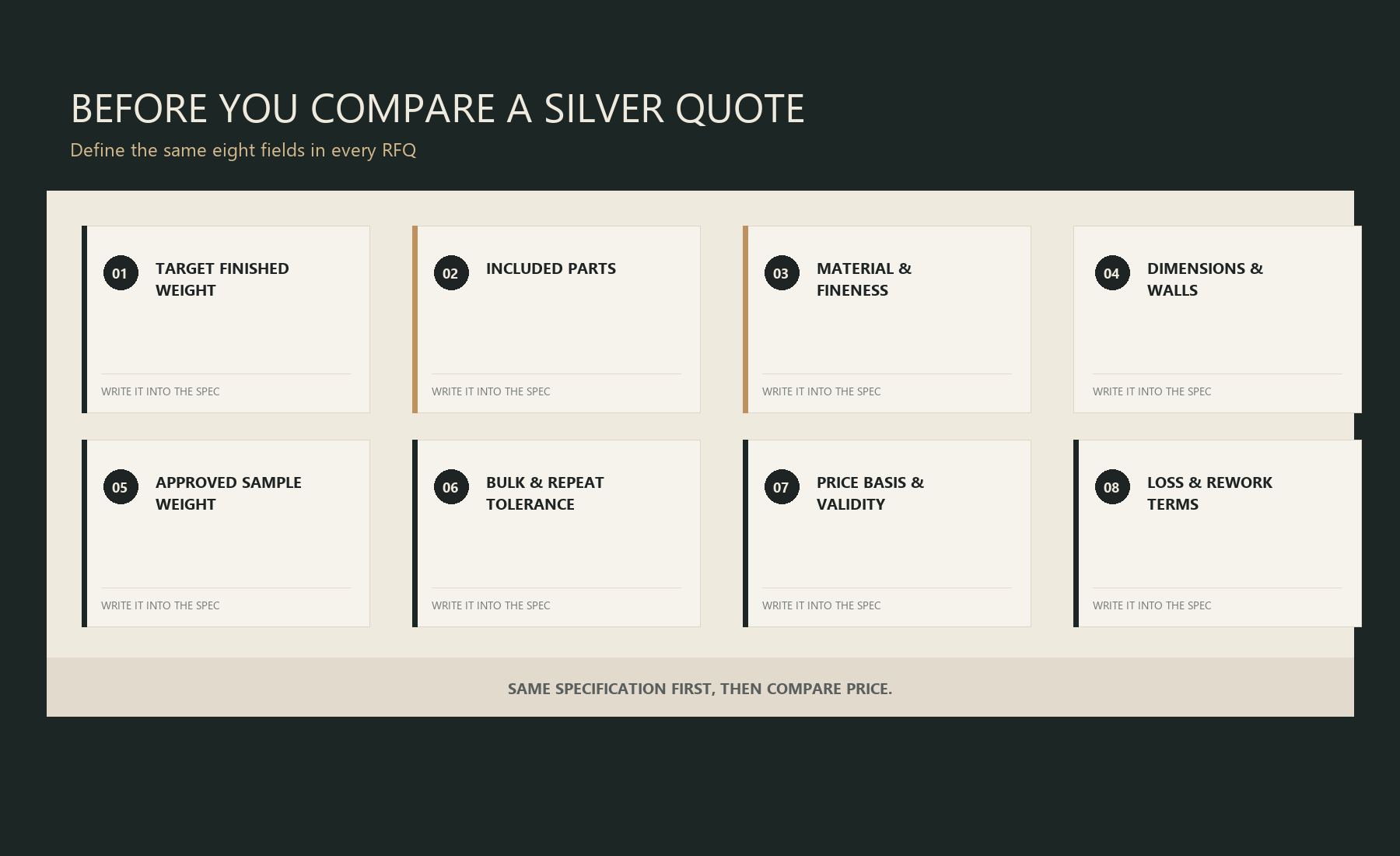
A quote becomes easier to compare when the weight basis is written into the request. Add these eight fields to the tech pack:
- Target finished weight or permitted range, expressed per piece.
- Measurement scope: specify stones, chain, findings, jump rings, tags and removable parts.
- Critical dimensions and wall areas, marking load-bearing or wear-sensitive locations.
- Material and fineness, including the required 925 sterling silver basis.
- Approved sample weight, with sample ID and CAD/version reference.
- Bulk and reorder tolerance, plus how measurements will be sampled and recorded.
- Metal-price basis date and quote validity, without treating a market benchmark as the factory purchase price.
- Tooling, recovery, loss, remake and rework terms, including who approves design changes.
Use the jewelry tech pack guide for drawings and revision control. For supplier qualification, review qualification and testing documentation and request order-specific evidence.
Jewelry Weight Consistency: Five Questions for Suppliers
When quotations arrive, avoid ranking them by unit price alone. Ask each supplier the same five questions:
- Which silver-price basis and date does the quote use?
- Is the stated weight an estimate, a CAD calculation, or a measured physical sample?
- How is production weight variation sampled, recorded and reported?
- Who must approve a weight-reduction or geometry change?
- How are the approved version and weight standard locked for reorders?
Answers should be specific enough for approval terms. For broader process review, see the sterling silver OEM supplier-vetting checklist.
FAQ: Rising Silver Prices and Jewelry Manufacturing
Should I make every design thinner when silver prices rise?
No. Blanket thinning may affect durability, casting fill, finishing access or perceived quality. Start with a design-specific DFM review and distinguish non-structural volume from functional areas.
Should a quote include a target finished weight?
Yes, preferably as a range with a clear measurement scope. Also identify whether the figure is estimated, CAD-calculated or taken from an approved sample.
How should a brand compare quotes issued on different dates?
Ask suppliers to state the price basis date, quote-validity period, weight basis and included process terms. Then normalize those assumptions before comparing unit prices.
Can silver weight be reduced after the mold is made?
Sometimes, but post-tooling changes can require CAD revision, mold work or a new sample. Review manufacturability before tooling whenever possible instead of assuming a late weight change is simple.
Discuss manufacturability before sampling: submit one 925 silver design, its target finished-weight range, and expected quantity through the project inquiry form. We can discuss structure, measurement scope and quotation assumptions before sampling; any design change, weight outcome and schedule remain project-specific.
 anya907888