



How to Vet a Sterling Silver OEM Supplier in 2 Weeks: A 7-Step Checklist for Founders
How to Vet a Sterling Silver OEM Supplier in 2 Weeks: A 7-Step Checklist for Founders
.jpg)
Most jewelry founders spend three months vetting a sterling silver OEM supplier and still end up with the wrong one. They compare price quotes, request a sample, like what arrives, and place a bulk order — then discover the sample was made by a different workshop than the production run. This guide compresses supplier vetting into 14 days using a 7-step checklist built around the questions that actually predict whether a factory can execute your brand.
Why This Matters More in 2026 Than It Did in 2020
Two things changed. First, EU and UK compliance documentation requirements tightened — a supplier who cannot produce current third-party test reports is no longer a "cheaper option," they are a shipment that gets held. Second, silver spot prices have made material cost a smaller share of your unit economics than rework, delays, and returns.
That shifts what you should be screening for. Price per piece is now the least useful comparison metric between two suppliers. Consistency between sample and bulk, documentation depth, and response speed under pressure predict your actual landed cost far better.
The 7-Step Vetting Checklist
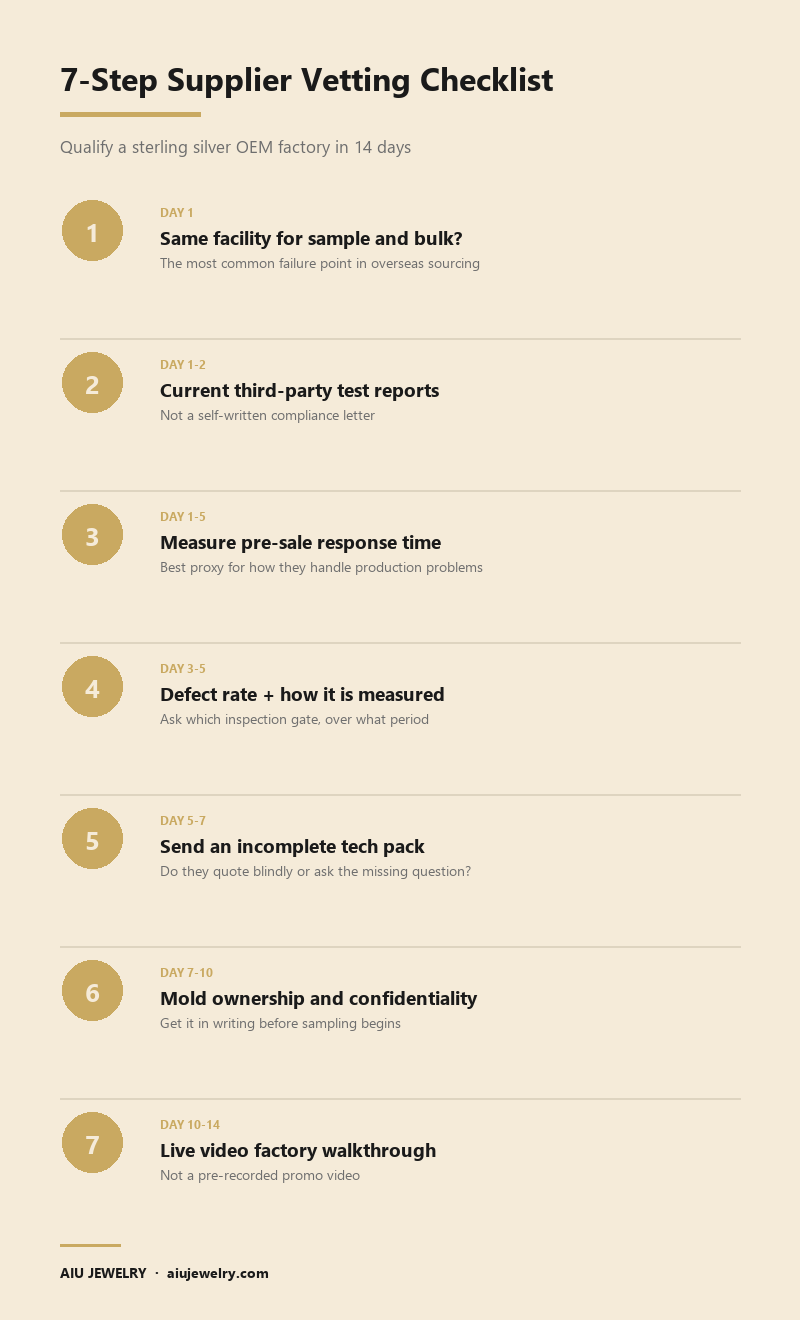
Step 1 — Ask who makes the sample vs. who makes the bulk (Day 1)
What: Send one question by email: "Is my sample produced in the same facility, by the same team, as bulk production?"
Why: This is the single most common failure point in overseas jewelry sourcing. Many trading companies outsource samples to a high-skill workshop and bulk to whoever is cheapest that month. Your sample approval becomes meaningless.
How AIU handles it: Samples and bulk run through the same 500 m² facility in Dongguan, with the same 3 mold masters overseeing both. Our repeat-client rate reaches 98.8% (based on 2024–2025 client order records), largely a function of that continuity.
Step 2 — Request their current compliance documentation (Day 1-2)
What: Ask for third-party test reports covering your target market — not a "compliance letter" written by the supplier.
Why: A supplier who needs two weeks to produce a test report either doesn‘t have one, or is about to commission one. Both tell you something. If you sell into the EU market, check our detailed guide on interpreting EN 1811 nickel release test reports for 925 sterling silver before reviewing supplier documentation.
How AIU handles it: Our current representative reports are on file and can be shared under NDA within 24 hours — see the certification and honor page for the formats we work with.
Step 3 — Measure response time before you‘re a customer (Day 1-5)
What: Track how long each supplier takes to answer three consecutive emails.
Why: Pre-sale response time is the best available proxy for what happens when something goes wrong mid-production. A supplier who takes 48 hours to answer a sourcing question will not solve a plating defect faster.
How AIU handles it: Our standard is a ≤ 3-hour response during business hours, and it applies to prospects and existing clients equally.
Step 4 — Ask for a defect rate number, then ask how it‘s measured (Day 3-5)
What: Request their internal defect rate, then ask the follow-up: "Measured at which inspection gate, and over what period?"
Why: Any supplier can quote a low number. The follow-up question separates factories with a real QC system from those quoting a marketing figure. If they cannot name the inspection gate, the number is decorative.
How AIU handles it: We track a 0.03% final-inspection defect rate (based on our internal QC records over the past 12 months, measured at final inspection before packing). These QC logs are available for review during a factory audit.
Step 5 — Send a deliberately incomplete tech pack (Day 5-7)
What: Leave out one specification — plating thickness, clasp type, or stone setting depth — and see what happens.
Why: A supplier who quotes anyway is guessing, and will guess again during production. A supplier who asks you the missing question is doing engineering review. That difference is worth more than a 10% price gap.
How AIU handles it: Our 5 in-house designers run a spec review on every incoming tech pack and return a written question list before quoting. You can review our custom jewelry construction capabilities in our project portfolio.
Step 6 — Ask about mold ownership and design confidentiality (Day 7-10)
What: Get written answers to: Who owns the mold after production? Can my design be shown to other clients? What happens to the mold if I stop ordering?
Why: Mold custody is the most commonly skipped conversation in first-time overseas sourcing, and the most expensive one to have later. Verbal assurances are not enforceable across borders.
How AIU handles it: Mold custody and design confidentiality terms are set in writing before sampling begins, not after. We own 4 valid utility patents related to sterling silver jewelry manufacturing, and treat client design protection with the same process discipline.
Step 7 — Run a video factory walkthrough before you pay a sample fee (Day 10-14)
What: Request a live video call — not a pre-recorded factory video — and ask to see the casting area, the polishing line, and the QC bench.
Why: A pre-recorded video proves nothing about who you are actually working with. A live walkthrough where you choose what to look at is the cheapest due diligence available.
How AIU handles it: We run 30-minute live factory walkthroughs on request, covering casting, polishing, plating, and final QC.
Red Flags Worth Walking Away From
- They quote before asking any questions. A quote without an engineering question is a placeholder number that will change after you commit.
- They won‘t name their inspection gates. "We have strict QC" without a described process means there is no process.
- Compliance documents arrive as photos of photos. A supplier with real reports can send you a clean PDF with a verifiable report number.
- They agree to every deadline immediately. A factory that never pushes back on a timeline is either not planning production or not being honest.
- The sample is dramatically better than anything in their catalog. Ask directly whether the sample was made in-house.
What a Good First Order Looks Like
Don‘t lead with volume. A sensible first engagement with a new sterling silver OEM supplier runs in three stages: a paid sample round on 2-3 SKUs, a small trial production run to test consistency at scale, then your first real bulk order once sample-to-bulk variance is proven.
This sequence costs more per unit up front and saves substantially more in avoided rework. It also gives you a documented performance record with that supplier before you have inventory risk on the line. With 60,000 pieces of monthly capacity and 22 years of manufacturing history, we structure new client relationships this way by default — the trial run exists to protect both sides.
.png)
Ready to start the 14-day clock? Send us your top 3 sketches or reference images — we‘ll return sample quotes, a material comparison (925 silver vs. 316L vs. eco brass), and a written spec question list within 48 hours. No commitment required.
 anya907888