



How to Read a 925 Silver EN 1811 Nickel-Release Report: A Buyer‘s Checklist for EU Compliance
How to Read a 925 Silver EN 1811 Nickel-Release Report: A Buyer‘s Checklist for EU Compliance
.jpg)
If you‘re sourcing 925 sterling silver jewelry for the EU market in 2026, the single document your customs broker, retailer, or QA lead is most likely to ask for is an EN 1811 nickel-release report. Yet most brand founders receive a PDF from their supplier, see "PASS" at the top, and file it. That‘s how non-compliant batches reach shelves — and how EU market surveillance actions get triggered.This guide walks you through the 6 checks that separate a defensible report from a decorative one, so you can vet your supplier‘s documentation in under 15 minutes.
The Real Problem: A "PASS" Means Nothing Without Context
EN 1811:2023 is the harmonized standard the EU uses to enforce REACH Annex XVII Entry 27 — the nickel-release limit for articles in prolonged skin contact. The rule is simple: nickel release must stay below 0.5 μg/cm²/week after simulated wear (or 0.2 μg/cm² for post assemblies inserted into pierced skin).
But a single-line "PASS" statement leaves five questions unanswered:
- Which specific components were tested (chain, clasp, stone setting, post)?
- Was the sample subjected to EN 12472 abrasion simulation before the nickel test, or straight to the leaching bath?
- Which accredited laboratory ran the test — and are they on the UKAS/CNAS register?
- Is the report scoped to the SKU you‘re actually buying, or to a "representative sample" that doesn‘t share the same plating stack?
- When was the report issued, and does it still reflect the current production batch?
EU customs authorities in 2025-2026 have escalated documentation checks on jewelry shipments coming out of Asia. A generic "compliance letter" from your supplier will not survive a market surveillance inquiry. What survives is a UKAS-accredited laboratory report tied to specific part numbers and dated within the current production cycle.
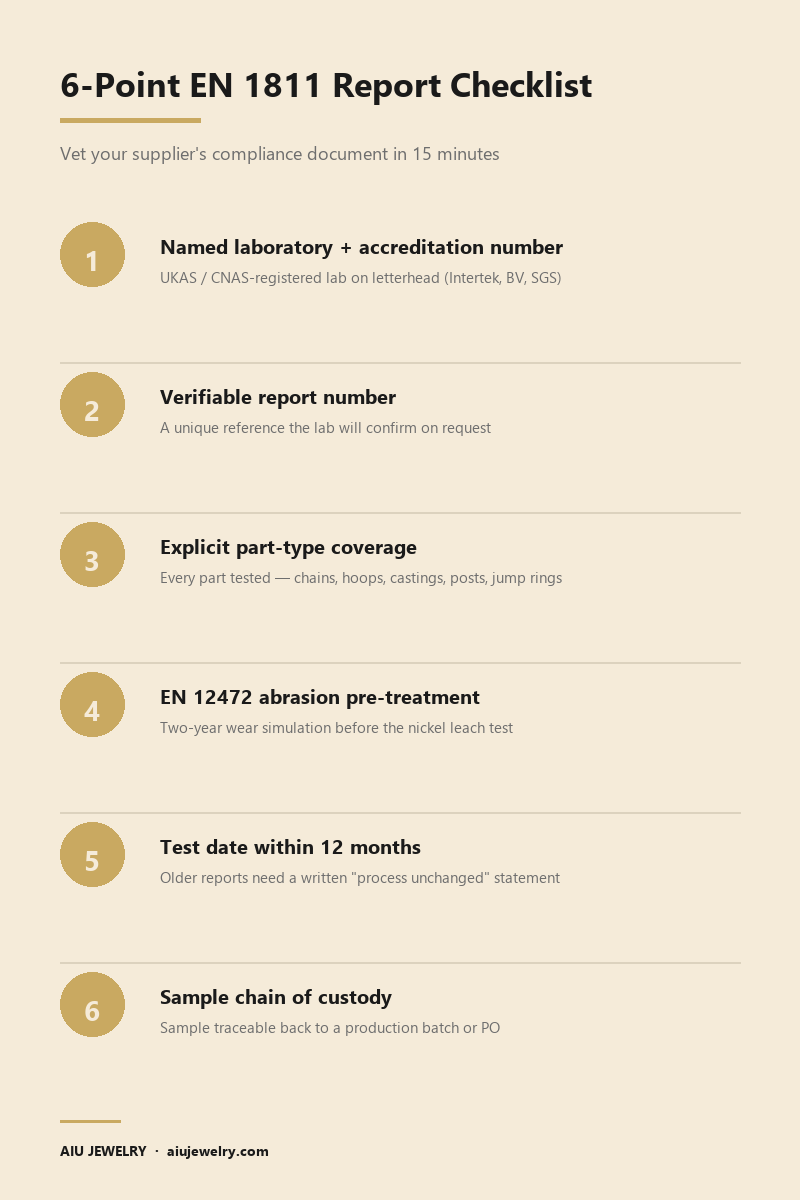
What to Look For: A 6-Point EN 1811 Report Checklist
1. Named laboratory + accreditation number
The report should carry the letterhead of a UKAS-accredited testing house. In the jewelry supply chain, the three names EU buyers recognize immediately are Intertek (AnchorCert Pro 2), Bureau Veritas, and SGS. If the report letterhead is a lab you have never heard of and cannot find on a national accreditation body‘s register, treat it as untested.
2. Report number that survives verification
A legitimate report has a unique reference number (e.g. TSNH00597757-1) that the laboratory will confirm on request. If your supplier resists sharing the number in plain text — or the number cannot be verified with the lab‘s front desk — the document is suspect.
3. Explicit part-type coverage
A well-scoped report lists every part type tested — not just "sterling silver ring". You should see line items for chains, hoops, castings, jump rings, studs, stone-set castings, buckles, tail chains, and posts as applicable. A report covering 36 distinct part types, for example, tells you the supplier has invested in comprehensive testing rather than a single-SKU cover story.
4. EN 12472 abrasion pre-treatment (where required)
For plated jewelry, EN 1811 alone tests only surface nickel release. EN 12472:2020 simulates two years of wear-and-tear abrasion before the nickel test — exposing whether the plating stack holds up in real use. If your target market includes the EU and your products are plated, look for reports that explicitly bundle EN 12472 with EN 1811. Bureau Veritas reports commonly include this pairing.
5. Test date within 12 months
An EN 1811 report older than one year is fine as historical evidence but weak as current compliance evidence, especially if the supplier has changed alloy sources or plating chemistry since. Ask for reports dated within the past 12 months, or ask the supplier to confirm in writing that the production process is unchanged since the report date.
6. Sample chain of custody
The report should describe how the sample was submitted (client-supplied vs. lab-drawn), what the sample represents (production batch, R&D sample, or master mold), and — ideally — reference an internal AIU batch number that ties back to your PO. Anonymous "sample provided by client" reports are common; sample-to-PO traceability is rare and a strong quality signal.
How AIU Handles It: The Documentation Layer Behind Our 925 Silver
At AIU, EN 1811 compliance is not treated as a per-project fire-drill. It is embedded in our production QC layer, backed by a 0.03% defect rate (last 12 months, internal QC data) and a 98.8% repeat-client rate — numbers that would collapse if compliance were reactive rather than systematic.
Our 925 sterling silver line is tested continuously under the Intertek AnchorCert Pro 2 program, which is the specific Intertek scheme designed for the fine-jewelry industry. The current representative report, TSNH00597757-1 (issued June 2026), covers 36 distinct part types — pins, hoops, castings, jump rings, chains, studs, stone-set castings, buckles, tail chains, logos, ring chains, caps, and ball beads — tested against EN 1811:2023 nickel release and REACH Annex XVII Entry 27, 63, and 23.
For buyers whose supply chain risk model requires an additional independent lab, we also maintain a parallel Bureau Veritas EU REACH COC (report (8526)012-0684) which bundles REACH Annex XVII 23/27/63, EN 1811:2023, and EN 12472:2020 abrasion simulation — the EN 12472 layer is what makes this report the go-to reference for buyers whose retail or marketplace partners require abrasion-tested documentation before onboarding new jewelry SKUs.
You can see the full material and gemstone range these reports cover across our 925 sterling silver project portfolio and the corresponding certification and honor page.
Compliance Documentation We Provide
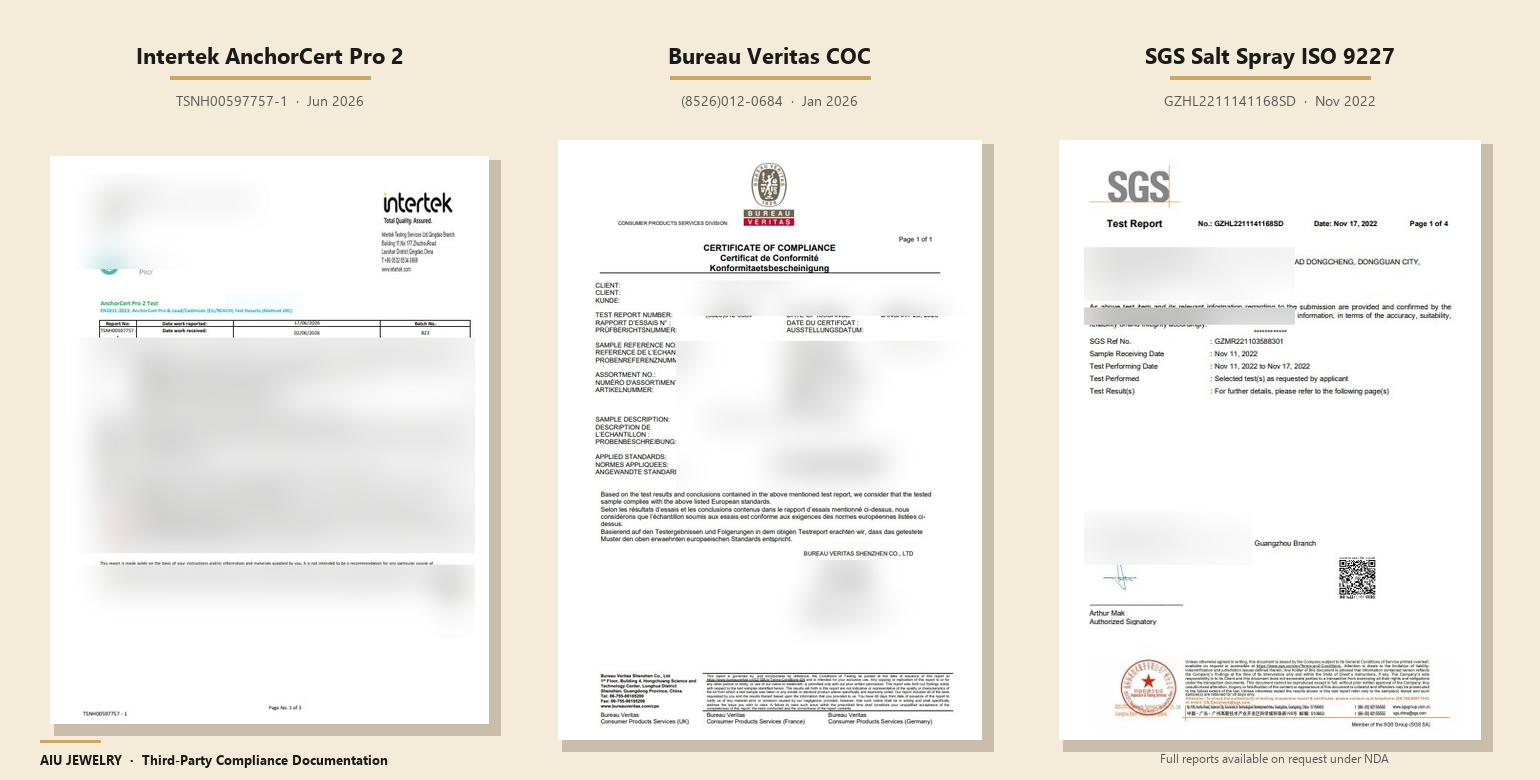
For every 925 sterling silver project, we can share the following three third-party reports covering the EU compliance perimeter:
| Report # | Laboratory | Scope | Issued |
|---|---|---|---|
TSNH00597757-1 |
Intertek (AnchorCert Pro 2) | EN 1811:2023 + REACH Annex XVII 27/63/23 · 36 part types | Jun 2026 |
(8526)012-0684 |
Bureau Veritas | REACH Annex XVII 23/27/63 + EN 1811:2023 + EN 12472:2020 | 2025-2026 range |
GZHL2211141168SD |
SGS | ISO 9227:2017 · 72-hour neutral salt spray · Rating 10 | 2025 |
The salt spray report (SGS GZHL2211141168SD) is not an EN 1811 substitute — it tests plating durability, not nickel release — but it complements the compliance stack when your product line includes plated silver components and your retail partner wants abrasion-and-corrosion evidence in one folder.
Additional product-specific reports are available on request under NDA, scoped to your PO and target market. See our full list of published test summaries for reference formats.
Frequently Asked Questions
Do I need a separate EN 1811 report for every SKU?
Not necessarily. EU authorities accept part-type-based reports if the supplier can demonstrate that the tested parts are representative of the SKU‘s construction (same alloy, same plating stack, same contact surface). Ask your supplier which report covers your specific SKU family and whether the report scope explicitly lists the part types in your product.
What‘s the difference between EN 1811 and EN 12472?
EN 1811 measures nickel release from a finished surface. EN 12472 simulates two years of wear-and-tear abrasion first, then submits the abraded sample for EN 1811 testing. For plated jewelry sold in the EU, EN 12472 + EN 1811 together is the defensible pairing — plain EN 1811 on virgin plating can miss failures that emerge only after normal use.
How often should EN 1811 reports be renewed?
Renew when: (a) the report is over 12 months old, (b) the supplier has changed alloy or plating chemistry, (c) you‘re entering a new EU country with stricter national enforcement (Germany and the Nordics are typically most active), or (d) your retailer‘s QA team requires a report dated within a specific window.
Nickel is one requirement among several, and which ones apply to you depends on where you sell. Our buyer‘s guide to jewelry test reports by market maps the full evidence set for the EU, the US and the UK in one comparison table.
Ready to see our current EN 1811 and Bureau Veritas reports for your product category? Reply with your target market (EU / UK / US) and your part-type list — we‘ll send the matching reports and a documentation-gap preview against your current supplier‘s paperwork within 24 hours, under NDA. No commitment required.
 anya907888