



Jewelry Plating Engineering: Electroplating, Gold Vermeil and Vacuum PVD Explained
In professional jewelry manufacturing (OEM/ODM), a surface finish is governed by an integrated coating system: the chemical composition of the substrate, precision pre-treatment and polishing, intermediate barrier layers, deposited coating thickness, and final sealing technologies. Understanding these differences allows brands to make informed decisions that match their product category, target price tier, and wear expectations.
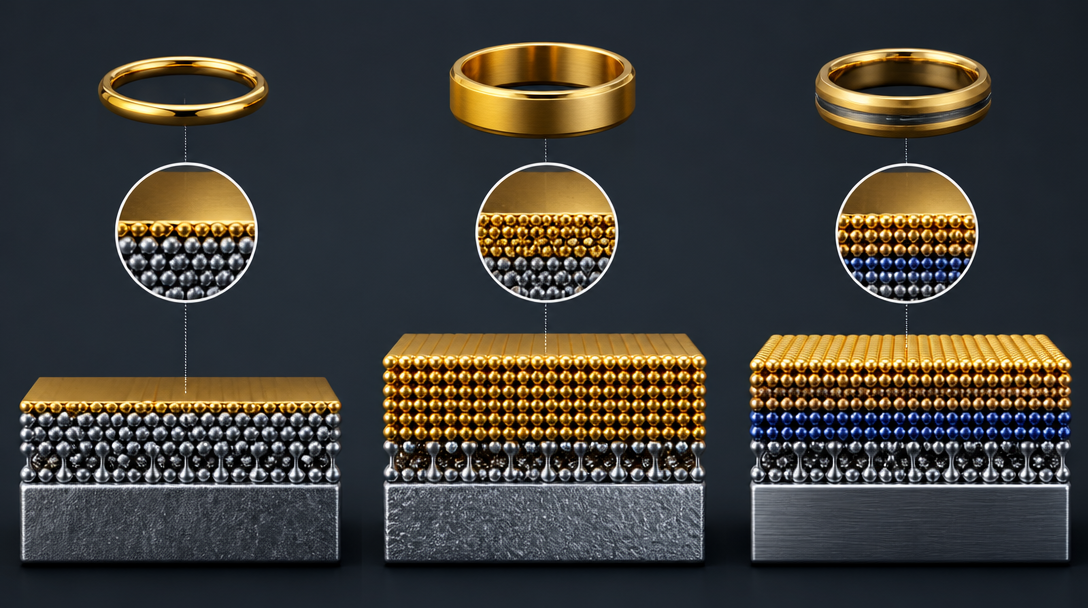
Figure 1: Microscopic cross-section comparison illustrating bonding mechanics and layer structures across three primary jewelry coating systems.
1. Three Primary Jewelry Coating Systems
Jewelry coating technologies operate on fundamentally different chemical and physical principles. The table below outlines their core engineering benchmarks:
| Coating System | Deposition Principle | Typical Thickness Range | Primary Strengths & Boundaries |
|---|---|---|---|
| Flash / Decorative Electroplating | Wet chemical electrolysis; dissolved gold ions deposit via electrical current in aqueous bath | 0.03 µm – 0.25 µm (Flash / Micro-dip) | Economical; delivers authentic gold color tone; limited abrasion resistance for friction-heavy pieces |
| Gold Vermeil (Electroplated Gold on Sterling Silver) | Heavy electrolytic gold electroplating over genuine 925 sterling silver base under calibrated current density | ≥ 2.5 µm fine gold equivalent | Substantial real gold layer; rich warm luster; meets US FTC fine jewelry designation criteria |
| Vacuum Ion PVD Coating | Physical Vapor Deposition inside high-vacuum chamber via plasma bombardment and vaporized targets | 0.5 µm – 2.0 µm (Application dependent) | Strong adhesion and good wear/sweat resistance when process parameters and substrate preparation are controlled |
A. Flash Electroplating (Wet Chemistry)
In wet electroplating, cleaned metal parts are immersed in an electrolytic tank. Direct electrical current reduces metal ions dissolved in the chemical bath, depositing a uniform metallic film onto the substrate (see our detailed guide on Plating Thickness in Microns). While flash plating provides an immediate, brilliant luster at an accessible production cost, its micro-thin layer is susceptible to wear in rings and bracelets subject to frequent contact.
B. Gold Vermeil: The Technical Definition under US FTC Standards
To qualify as Gold Vermeil under the US Federal Trade Commission (FTC) Jewelry Guides, the product must fulfill three technical requirements simultaneously:
- Base Substrate: Must be genuine Sterling Silver (925/1000 purity);
- Gold Fineness: The coating must consist of gold or gold alloy of not less than 10K fineness;
- Equivalent Thickness: The plating must have a minimum thickness equivalent to 2.5 microns (approximately 100 micro-inches) of fine gold across all significant surfaces.
Because electroplating deposition is cumulative, achieving a true 2.5µm equivalent deposit requires extended tank dwell times, precise replenishment of dissolved gold salts, and calibrated agitation to maintain uniform thickness across intricate recesses and sharp prongs.
C. Vacuum Ion PVD (Physical Vapor Deposition)
Unlike wet chemical plating, PVD takes place inside a specialized vacuum chamber under plasma discharge conditions. Depending on the coating system, PVD uses metallic or compound targets, sometimes combined with reactive gases such as nitrogen, to form functional coating layers topped with a fine gold surface layer. When properly engineered and applied, PVD coatings provide strong adhesion and good wear resistance. Actual performance depends on substrate preparation, coating composition, layer structure, and process parameter control.
2. Gold Karat vs. Color Specification & Protective E-Coating
A. Engineering Rule: Gold Karat Specification ≠ Gold Color Specification
In jewelry manufacturing, a common point of confusion is treating gold karat as a visual color description. In technical reality, Gold Karat measures alloy purity (e.g., 18K = 75.0% gold content), whereas Gold Color is an optical property determined by the specific alloying elements co-deposited during the final flashing cycle:
- 14K Champagne Gold: Co-deposited with a balanced silver/copper ratio, yielding a contemporary pale gold tone;
- 18K Classic Yellow Gold: The global standard for luxury jewelry, balancing warmth and optical saturation;
- 24K Rich Gold: High-purity deposit displaying a deep, intense yellow hue favored in artisanal and heritage designs;
- Rose Gold: Formulated with controlled copper co-deposition to achieve warm pink-to-reddish tones.
Alternative Precious Metal Finishes:
- Rhodium Finish: A rare platinum-group metal electroplated over silver or brass, providing brilliant neutral white reflectivity and tarnish resistance.
DFM Best Practice: Brands should provide physical color coupons or standard $L^*a^*b^*$ colorimetric targets rather than specifying karat designations alone.
B. Protective E-Coating (Electrophoretic Lacquer)
A properly applied and cured E-coating can provide an additional protective barrier, helping reduce exposure to moisture, atmospheric contaminants, and everyday cosmetic residues. Its effectiveness depends on film coverage, curing conditions, substrate preparation, and wear exposure.
3. What Determines Jewelry Coating Durability?
Coating thickness is an important quality parameter, but it does not independently determine the durability of finished jewelry. In OEM/ODM manufacturing, actual performance is influenced by several interconnected factors:
- Surface Preparation & Cleanliness: Residual polishing compounds, surface oxides, or micro-porosity in crevices can severely impair atomic adhesion, leading to premature flaking regardless of thickness.
- Barrier Layer Design: An appropriate intermediate barrier layer, selected for the substrate and coating system, helps limit base-metal diffusion (such as copper migration) and supports coating stability.
- Coating Coverage on Complex Geometries: Recesses, sharp corners, micro-prongs, and inner ring bands receive varying electrical field densities during electroplating, resulting in local thickness variations.
- Product Geometry & Contact Zones: High-friction pieces like ring shanks and mechanical clasps experience concentrated abrasive shear forces compared to pendant drops and earrings.
- Final Sealing Technologies: Protective electrophoretic topcoats provide crucial supplementary barriers against environmental and chemical wear where the coating system requires them.
Manufacturing Insight: For OEM/ODM production, coating specifications should therefore be evaluated together with substrate selection, product geometry, finishing processes, and agreed performance tests rather than relying on thickness numbers alone.
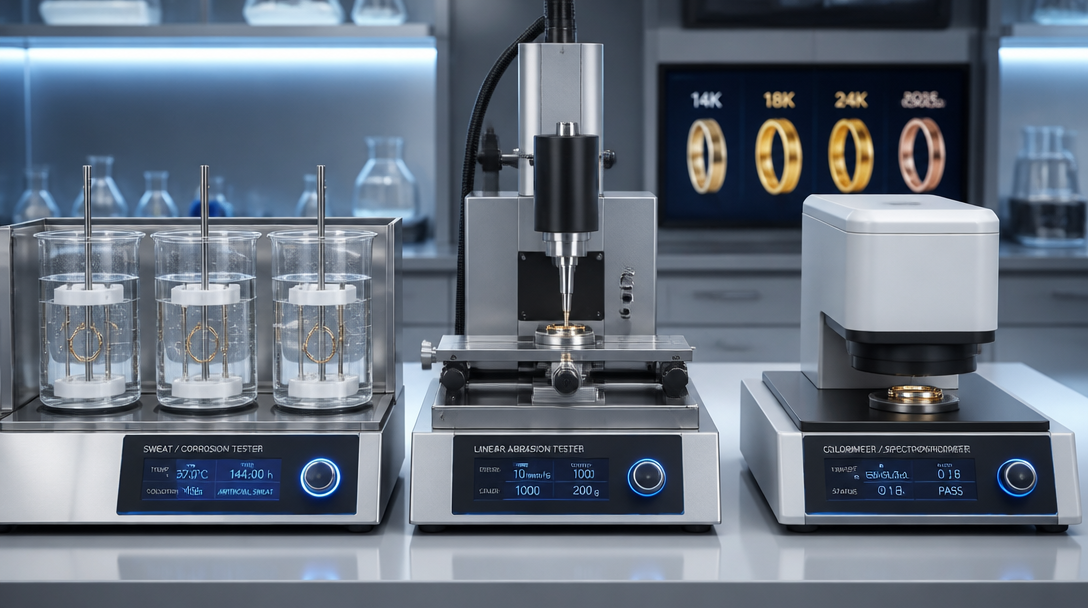
Figure 2: Laboratory testing setup for coating quality control: artificial sweat immersion, linear abrasion testing, and spectrophotometer color comparison.
4. Durability & Laboratory Testing Protocols
Durability in jewelry should never be stated as an absolute, open-ended promise such as "permanently tarnish-free". Instead, professional manufacturers evaluate wear performance using standardized laboratory testing protocols (see our QA standards on Sample to Mass Production Consistency):
1. Artificial Perspiration / Sweat Corrosion Exposure
Evaluates surface discoloration, pitting, and plating breakdown when exposed to synthetic perspiration formulations under controlled temperature chambers. Test solution, temperature, exposure duration (e.g., 24h, 48h, or 96h), and acceptance criteria should be defined according to the applicable test method or agreed customer specification.
2. Linear Abrasion & Friction Wear Testing
A weighted mechanical arm rubs across coated contact surfaces and sharp edges over specified reciprocal cycles to assess practical mechanical wear resistance under contact loads.
3. Regulatory Nickel Release Evaluation (e.g., EN 1811)
Specifically evaluates nickel migration rates for skin-contact compliance under EU REACH Annex XVII regulations, distinct from general corrosion tests.
4. Spectrophotometer Color Consistency ($L^*a^*b^*$ Coordinates)
Sample batches are measured against an approved physical golden color master using standardized color coordinates to verify batch-to-batch visual consistency within agreed Delta-E tolerances.
5. Substrate & Coating Compatibility Matrix
Selecting the right coating technology depends heavily on the base metal (see our comprehensive 925 Silver vs. Brass vs. 316L Stainless Steel Decision Guide):
| Base Metal Substrate | Recommended Coating Route | Pre-Treatment & Key Controls | Target Commercial Positioning |
|---|---|---|---|
| 925 Sterling Silver | Gold Vermeil (≥2.5µm) / Rhodium / Heavy Micron Plating | Palladium/barrier layer + calibrated gold deposit + protective seal | Demi-fine keepsakes, boutique designer jewelry, heirloom fine lines |
| Lead/Nickel-Controlled Brass | Multi-Layer Wet Electroplating + Baked E-Coat | Acid copper leveling layer + dense barrier layer + real gold + e-coat | Contemporary statement pieces, chunky runway hoops, architectural fashion cuffs |
| 316L Stainless Steel | Vacuum Ion PVD Coating (18K Gold / Black / Rose Gold) | Ultrasonic precision degreasing + TiN adhesion layer + fine gold top layer | Everyday lifestyle jewelry, modern minimalist designs, and durable fashion accessories |
6. Practical Example: Developing a Gold-Tone Ring Collection
To illustrate how engineering decisions connect design, material, and surface finishing, consider a brand planning a new collection of gold-tone rings:
- If developed in 925 Sterling Silver: The optimal route is Gold Vermeil. The Tech Pack should specify a minimum 2.5µm fine gold equivalent deposit, an 18K yellow color master, and an appropriate barrier layer selected for the substrate and coating system to help limit base-metal diffusion and deliver fine jewelry prestige.
- If developed in Controlled Brass: Suitable for voluminous, sculptural statement designs. The finish should specify multi-layer electroplating (copper leveling + barrier layer + real gold) with a baked electrophoretic lacquer (E-coating) to provide surface protection at an accessible price point.
- If developed in 316L Stainless Steel: Tailored for minimalist everyday lifestyle wear. The specification should require Vacuum Ion PVD Coating with validated plasma pre-treatment and adhesion controls, paired with sweat and friction resistance testing.
7. How to Specify Surface Finishing in Your Tech Pack
To avoid ambiguous quotations and mismatched sampling results, brands should provide explicit surface finishing specifications in their production Tech Pack (see our Tech Pack Checklist):
- Target Coating Method: Specify whether the requirement is Wet Chemical Electroplating (with exact micron depth, e.g., 0.5µm, 1.0µm, 2.5µm Vermeil) or Vacuum Ion PVD Coating;
- Target Color & Physical Master: Specify 14K Champagne, 18K Classic Yellow, 24K Rich Yellow, Rose Gold, or Rhodium, referencing a physical color coupon or Delta-E threshold;
- Barrier & Sealing Requirements: State whether barrier layers and electrophoretic lacquer (E-coating) are required;
- Target Acceptance Testing: State required laboratory criteria (e.g., synthetic sweat exposure test, abrasion test, or nickel-release requirements) if third-party certification is needed for your distribution channel.
8. Frequently Asked Questions (FAQ)
Q1: Can 925 Sterling Silver be coated with PVD instead of traditional electroplating?
While specialized low-temperature PVD on silver is technically possible, conventional wet chemical electroplating and Gold Vermeil remain the standard for 925 silver. Wet electroplating achieves unmatched optical warmth and allows compliance with legal "Gold Vermeil" hallmarking standards.
Q2: What is the primary cause of premature plating wear on jewelry?
Premature wear is rarely caused by the gold bath alone; it is most commonly triggered by inadequate surface pre-treatment (residual polishing compound in crevices), absence of a proper barrier layer allowing base metal diffusion, or lack of protective E-coating on high-friction points like ring bands and clasps.
Q3: How does AIU Jewelry address chemical safety and compliance in surface finishing?
AIU Jewelry evaluates material and surface-finishing requirements against applicable market regulations. Where required, relevant product testing and supporting compliance documentation can be arranged for specific materials, finishes, and product configurations.
Develop Your Next Jewelry Collection With the Right Finishing System
Choosing the right surface finish starts with understanding your design, substrate, target market, and expected product performance. At AIU Jewelry, we support B2B brands with material selection, finishing process evaluation, prototyping, and production consistency.
Share your design drawings, target materials, and finishing requirements with our engineering team to evaluate the right manufacturing solution for your collection.
 anya907888
