



Manufacturing Gothic & Dark Romantic Jewelry at Scale: Oxidation, Detailing, and Polish Accessibility
From anatomical skulls, thorned botanical vines, and dragon claws to sacred architecture motifs, Gothic, Dark Romantic, and Alternative Jewelry has grown from an artisanal counter-culture niche into one of the most resilient, high-margin categories in the global designer jewelry market.
However, scaling Gothic and Dark Romantic jewelry from a one-off master bench sample into stable, high-yield mass production (OEM/ODM) presents unique manufacturing bottlenecks. Unlike minimalist geometric jewelry with broad, flat surfaces, Gothic pieces rely on deep negative space, multi-directional undercuts, sharp high-relief textures, and dramatic contrast between blackened oxidized crevices and mirror-polished ridges.

Figure 1: The standard 3-step surface finishing cycle for Gothic jewelry: full chemical sulfur immersion, selective manual relief polishing, and protective micro-sealing.
1. Core Engineering Challenges of Gothic Jewelry
In volume manufacturing, intricate sculptural aesthetics directly challenge conventional casting, rubber mold cutting, and finishing workflows:
| Manufacturing Stage | Typical Production Bottleneck | AIU DFM Engineering Solution |
|---|---|---|
| Wax Injection & De-molding | Deep undercuts, interlocking dragon claws, and hollowed eye sockets tear delicate wax patterns during mold extraction. | Multi-piece vulcanized rubber mold cutting (zig-zag parting lines) and modular CAD assembly splits. |
| Investment Casting | Heavy solid heads combined with thin band shanks cause shrinkage porosity and incomplete filling in fine filigree tips. | Strategically calibrated secondary feeder sprues and internal structural weight-relief hollows (see CAD Pre-Tooling Checks). |
| Chemical Oxidation | Inconsistent potassium sulfide dwell times cause grayish, patchy blackening that rubs off easily during wear. | Calibrated chemical immersion parameters (temperature, bath concentration, ultrasonic pre-clean) and transparent protective lacquer sealing. |
| Manual Contrast Polishing | Buffing wheels accidentally drag across dark recesses, washing out the intended shadow depth and blurring facial details. | Defined relief height thresholds (≥ 0.35 mm), custom mini-felt points, and selective rotary wheel access paths (see Manual Cleanup Standards). |
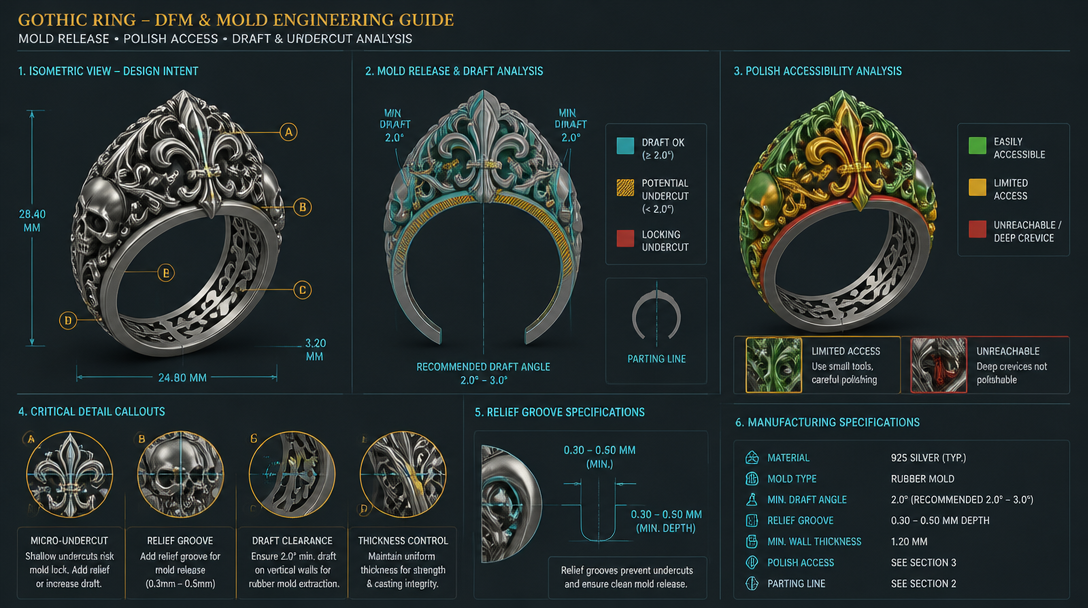
Figure 2: CAD Design-for-Manufacturing (DFM) rules: drafting relief angles, minimum groove depths, and multi-component split lines for complex Gothic motifs.
2. Rubber Mold Undercuts & Multi-Part Assembly Strategies
In single-piece bespoke crafting, a jeweler can spend hours hand-carving a master wax. In mass production, however, thousands of wax replicas must be injected and cleanly extracted from rubber molds without warping or tearing (see our protocol on Sample to Mass Production Consistency).
A. Identifying Severe Undercuts
Severe undercuts occur whenever a structural feature (such as an open jaw, curved horn, or deep eye socket) traps the vulcanized rubber during mold opening. For high-volume production, master rubber mold cutters use complex multi-segment puzzle cuts or liquid silicone cold-mold vulcanization to ensure clean wax release.
B. Modular CAD Splitting and Laser Micro-Welding
For ultra-complex sculptural items, trying to cast the entire piece as a monolithic unit often leads to high scrap rates. Our engineering team frequently splits complex designs into 2 or 3 interlocking sub-components:
- Main Chassis & Ring Shank: Cast and polished independently;
- Sculptural Overlays (e.g., Crown, Fangs, or Gemstone Claws): Cast separately to allow 360-degree polishing and precise oxidation;
- Precision Assembly: Joined post-finishing using high-precision Nd:YAG laser micro-welding with zero visible solder seam discoloration.
3. Controlled Oxidation & High-Contrast Polishing
The visual soul of Gothic 925 sterling silver jewelry lies in the dramatic contrast between pitch-black shadow crevices and mirror-bright raised ridges:
A. Chemical Sulfurization vs. PVD Black Plating
- Chemical Silver Oxidation (Liver of Sulfur / Potassium Sulfide Bath): Reacts directly with surface silver atoms to generate an authentic, organic Silver Sulfide (Ag₂S) layer. It delivers a rich velvety matte black that flows naturally into every microscopic depression;
- PVD Black Ion Coating (TiCN / DLC on Stainless Steel): Used on 316L stainless steel jewelry (see our Metal Selection Guide) where chemical silver oxidation is non-reactive, providing a sleek, durable, scratch-resistant modern black finish.
B. Selective Relief Polishing Sequence
To establish razor-sharp contrast across high-volume production runs, AIU follows a strict 3-stage finishing sequence:
- Full Immersion Oxidation: The entire raw casting is oxidized until an opaque, dense black layer forms across 100% of the surface;
- Graduated Relief Polishing: Bench technicians use mini-lapidary felt wheels and diamond paste to selectively buff the raised planes, transitioning from coarse smoothing to a high-luster mirror shine while leaving recessed textures untouched;
- Ultrasonic Neutralization & Anti-Tarnish Sealing: Ultrasonic bath in neutral detergent removes abrasive residues, followed by an invisible micro-polymer seal to lock in the black patina and prevent premature rub-off.
4. Designing for Polish Accessibility
A frequent design flaw in Dark Romantic jewelry CAD files is creating intricate recesses that are physically inaccessible to standard polishing tools:
Engineering Rules for High-Contrast Detailing:
- Minimum Shadow Groove Depth: Recessed texturing and background cross-hatching should maintain a minimum depth of 0.30 mm – 0.50 mm. Grooves shallower than 0.20 mm risk being accidentally wiped clean during final buffing.
- Clear Relief Draft Angle: Side walls of raised elements should feature a subtle draft angle (≥ 5°) to allow polishing tools to graze the crest without digging into the valley.
- Magnetic Pin Tumbling for Deep Cavities: For hollowed rib cages and filigree interiors where hand wheels cannot enter, magnetic stainless steel micro-pin tumbling cleans and brightens internal surfaces prior to final oxidation.
5. Gemstone Setting in Deep Sculptural Pieces
Dark Romantic jewelry frequently incorporates moody center gemstones—such as blood-red Garnet, deep black Onyx, iridescent Labradorite, or dark Moissanite. Setting stones into sculptural forms requires specialized engineering:
- Claw & Bezel Placement: Ensure claw prongs emerge naturally from anatomical features (e.g., bone joints, talon tips) with sufficient metal thickness (≥ 0.8 mm) to withstand setting pressure without cracking;
- Setting Sequence vs. Oxidation: Gemstones must be set after the primary chemical oxidation cycle to avoid acidic sulfur bath damage to porous or treated stones (like turquoise, emeralds, or pearls);
- Seat Accessibility: Ensure burr tools have direct perpendicular access to cut level gemstone bearing seats.
6. Tech Pack Checklist for Dark Aesthetics
When briefing your manufacturing partner for a Gothic or Dark Romantic collection, ensure your Tech Pack (see our Tech Pack Guide) specifies the following critical callouts:
- Oxidation Intensity & Tone: Specify whether the requirement is deep matte velvet black, antique gunmetal gray, or subtle smoky vintage shading;
- Polished Surface Boundaries: Clearly highlight on 3D renderings which surfaces must be high-luster mirror shine vs. which areas must remain 100% matte oxidized;
- Target Base Metal: Specify 925 Sterling Silver, Lead/Nickel-Controlled Brass, or 316L Stainless Steel;
- Assembly Tolerances: Detail laser weld seams and joint tolerances for modular multi-component castings.
Frequently Asked Questions (FAQ)
Q1: Will the black oxidation on 925 sterling silver rub off over time?
Black oxidation inside deep grooves and recessed textures remains stable for years because it is protected from direct friction. On high-contact outer edges, gentle natural wearing is characteristic of heirloom silver, which actually enhances the vintage organic character over time. AIU applies protective micro-lacquer seals to ensure maximum durability during retail handling and daily wear.
Q2: Can brass and stainless steel achieve the same oxidized look as 925 silver?
Brass can be chemically blackened or antique-bronze treated and sealed with e-coating. Stainless steel does not react with silver sulfur baths, but achieves an ultra-durable dark aesthetic through vacuum PVD black coating (DLC / TiCN) paired with precision laser engraving.
Q3: How does AIU support brands transitioning from handmade wax carving to volume casting?
Our engineering team can 3D scan your physical hand-carved master, optimize structural wall thicknesses and draft angles in CAD, and create multi-piece production master molds ready for high-yield volume casting while retaining 100% of your artistic soul.
Scaling Your Gothic or Dark Romantic Collection?
Intricate dark aesthetics require specialized mold-making, mastery of sulfur oxidation chemistry, and precision bench cleanup. AIU Jewelry provides end-to-end OEM/ODM engineering to bring complex sculptural designs to market with flawless repeat-order consistency.
Send your 3D CAD files, concept sketches, or physical master samples to our engineering team for a comprehensive DFM tooling and production review.
 anya907888
