



Children‘s Jewelry Compliance: CPSIA Testing, ASTM F2923 and What a Test Programme Actually Costs
.jpg)
Children‘s jewelry is the most heavily regulated category in the accessories market, and the rules changed for every importer on 8 July 2026, when CPSC electronic filing of compliance certificates became mandatory. If you are sourcing children‘s pieces and your supplier cannot hand you structured certificate data, your shipments are now exposed at the border.
Key takeaways
- There is no federal standard written specifically for jewelry. Children‘s jewelry is caught by the general children‘s-product rules instead, and by ASTM F2923 as industry best practice.
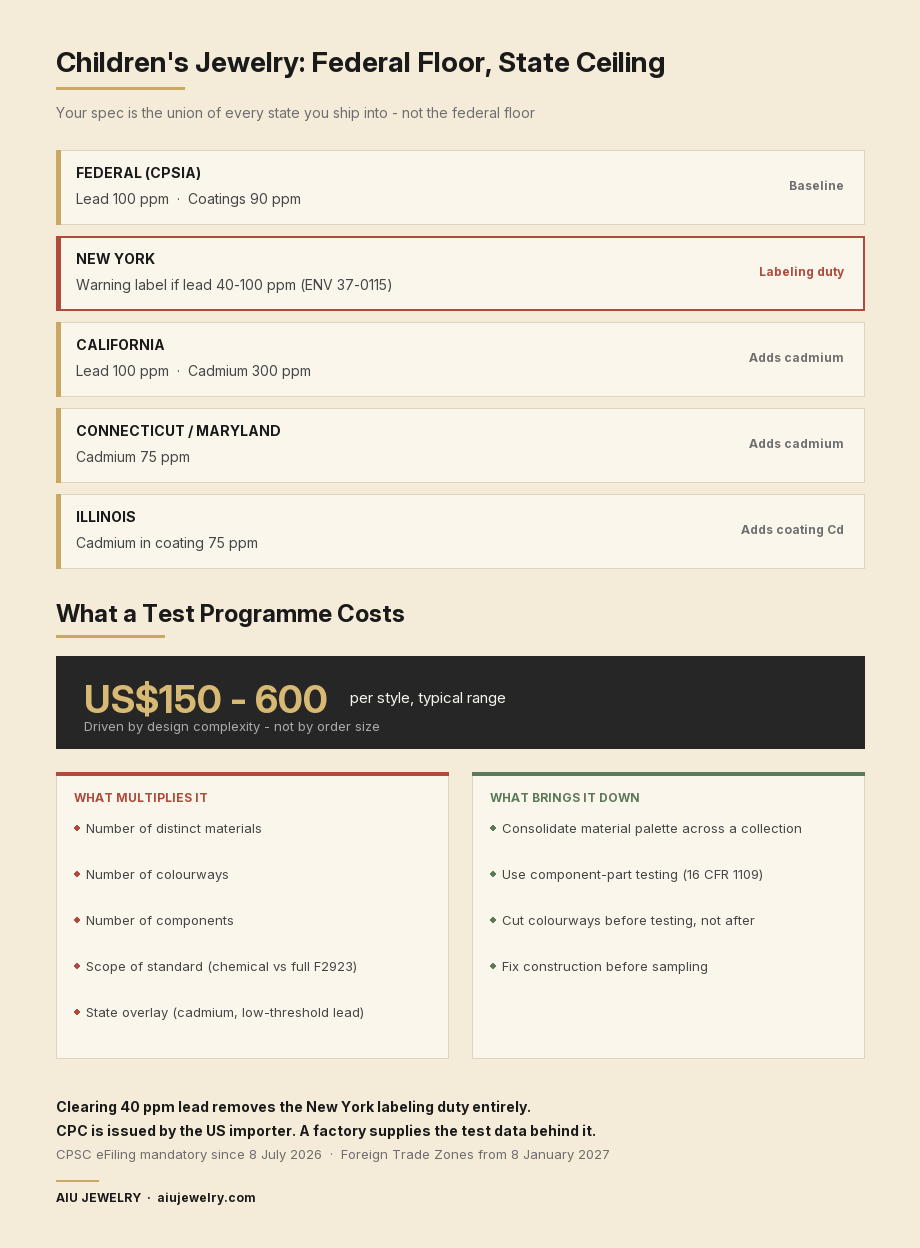
- State law adds obligations the federal floor does not. New York does not lower the 100 ppm ceiling — it requires a lead warning label on children‘s jewelry sitting between 40 and 100 ppm. Other states add cadmium limits where federal law has none.
- Only a US importer can issue the CPC. A factory certificate cannot be passed along. What a factory supplies is the test data the certificate is built on.
- Testing runs roughly US$150–600 per style in our experience, driven by how many test points a design creates — not by order value.
- eFiling has been mandatory since 8 July 2026. Certificate data must reach CPSC electronically before goods enter US commerce.
Jump to: the rule framework · substance limits · state law · what testing costs · CPC and eFiling · working with us · FAQ
Children‘s Jewelry Regulations: Which Rules Actually Apply
The first surprise for most buyers is what does not exist.
CPSC states there are no mandatory federal requirements written specifically for jewelry (CPSC jewelry FAQ). Children‘s jewelry is regulated because it is a children‘s product, not because it is jewelry.
That single distinction explains most of the confusion in supplier conversations. Three layers stack on top of each other:
- CPSIA general children‘s-product rules — total lead content, lead in surface coatings, third-party testing at a CPSC-accepted laboratory, a Children‘s Product Certificate, and a permanent tracking label.
- ASTM F2923 — the consensus standard written specifically for children‘s jewelry. CPSC confirms it is not incorporated by reference, so it is not law in itself. In practice it is the specification buyers, retailers and marketplaces ask for.
- State statutes — several states set limits below the federal threshold, and some add cadmium rules where federal law has none.
A supplier who says "we are CPSIA compliant" has told you almost nothing. The useful question is which of the three layers their report actually covers.
The Substance Limits That Apply to Children‘s Pieces
Federal thresholds for a children‘s product, set by the Consumer Product Safety Improvement Act at 15 U.S.C. §1278a and 16 CFR Part 1303:
- Total lead content: 100 ppm (0.01%) in accessible component parts — 15 U.S.C. §1278a(a)
- Lead in paint and surface coatings: 90 ppm (0.009%) — 16 CFR Part 1303
ASTM F2923 goes further than the federal floor. It addresses cadmium, nickel release, and mechanical hazards, and it is the standard most US retailers and marketplaces name when they ask for documentation.
Small parts matter as much as chemistry. Under 16 CFR Part 1501, a children‘s jewelry item that can fit inside the small-parts cylinder is treated as a choking hazard for under-3s. A clasp, a bead or a charm that detaches under normal use can fail a programme that passed every chemical test. Design and construction decisions carry compliance consequences here, not just cosmetic ones.
Why the Strictest State Sets Your Specification
This is where most sourcing plans go wrong. Buyers build to 100 ppm because that is the federal number, then discover a state limit underneath it.
| Jurisdiction | Restriction | Versus federal |
|---|---|---|
| Federal (CPSIA) | Lead 100 ppm; coatings 90 ppm | Baseline |
| New York | Warning label required when accessible component lead is 40–100 ppm in substrates, or 40–90 ppm in surface coatings (ENV §37-0115, eff. 1 Jan 2021) | Adds a labeling duty inside the federal band |
| California | Lead 100 ppm; cadmium 300 ppm; soluble cadmium in coating 75 ppm | Adds cadmium |
| Connecticut / Maryland | Cadmium 0.0075% (75 ppm) | Adds cadmium |
| Illinois | Cadmium in paint or coating 75 ppm | Adds coating cadmium |
If you sell nationally through a marketplace, you cannot control which state an order ships to. Your practical specification is the union of every state requirement in the set, not the federal floor.
In practice that means two different things. Cadmium is a hard content limit in California, Connecticut, Maryland and Illinois — miss it and the product cannot be sold. New York is a labeling duty rather than a content limit, but a warning label reading "CONTAINS LEAD. MAY BE HARMFUL IF EATEN OR CHEWED" on a children‘s product is a commercial problem regardless of its legality.
That is why serious programmes build to 40 ppm lead even though federal law permits 100. It is not that 40 ppm is the legal limit — it is that clearing 40 ppm removes the New York labeling obligation entirely, and no buyer wants a lead warning printed on a child‘s bracelet.
California runs the same two-track structure at state level: its Metal-Containing Jewelry Law (Health & Safety Code §§25214.1–25214.4.2) sets the content limits, while Prop 65 handles warnings. The former is the statute that catches children‘s jewelry specifically. We cover that split in our breakdown of Prop 65 and the Metal-Containing Jewelry Law.
What Children‘s Jewelry Testing Costs — and What Drives the Number
In our experience running programmes for client projects, a children‘s jewelry style typically tests in the US$150–600 range (indicative only, laboratory- and construction-dependent; not a quotation). That is a wide band, and the spread is not arbitrary. It tracks how many separate test points a design creates.
What multiplies your bill:
- Number of distinct materials. A sterling silver pendant on a steel chain with an enamel inlay is three material families, not one product.
- Number of colours. Each colourway of paint, enamel or plating is treated as a separate surface coating.
- Number of components. Limits apply per accessible component. Clasps, jump rings, beads and findings each count.
- Scope of standard. Chemistry alone is cheaper than chemistry plus the mechanical and small-parts battery in ASTM F2923.
- State overlay. Adding cadmium and low-threshold lead for the strictest states extends the panel.
What brings it down:
- Consolidate the material palette across a collection. Ten styles built from the same four validated materials test far cheaper than ten styles with ten palettes.
- Use component-part testing. Under 16 CFR Part 1109, validated component data can support certification across multiple finished designs instead of retesting each one from scratch.
- Cut colourways before testing, not after. Dropping two unpopular colours at design stage removes two coating panels from every affected style.
- Fix the construction first. Sending an unresolved sample means retesting after every change.
Testing cost is driven by design complexity, not by order size. A 200-piece order and a 20,000-piece order of the same style face the same test bill — which is why the cost lands hardest on small first orders and why palette discipline pays off early.
Quoted ranges vary between laboratories and change over time. Treat the band above as a planning figure and confirm a written quotation for your specific construction before you commit to a launch date.
The CPC and eFiling: Who Signs What
This is the part where responsibility is most often misunderstood, and getting it wrong is expensive.
CPSC is explicit (CPC guidance): the importer must issue the CPC for products manufactured overseas, and an importer cannot simply pass along a foreign manufacturer‘s certificate.
So the division of labour looks like this:
| Task | Who is responsible |
|---|---|
| Testing at a CPSC-accepted laboratory | Arranged by the factory or the importer; performed by the lab |
| Supplying test reports and component data | The factory |
| Issuing and signing the CPC | The US importer — legally, always |
| eFiling certificate data to CPSC | The importer or its customs broker |
| Permanent tracking label on product and packaging | The factory implements; the importer specifies |
Two useful facts. The CPC itself costs nothing to create — it is a document the importer drafts from passing test results, and CPSC publishes a model format. And under 16 CFR Part 1109, an importer may build its own CPC on a foreign manufacturer‘s component-part test results, provided it exercises due care and holds the required documentation.
What changed on 8 July 2026 is transmission, not obligation. Certificate data now has to reach CPSC electronically before goods enter US commerce. CPSC has stated that eFiling creates no new testing or certification duties — but it does mean incomplete or unstructured supplier documentation surfaces at the border rather than in a filing cabinet. Goods imported into Foreign Trade Zones come into scope on 8 January 2027.
Note: this article is general information about US requirements, not legal advice. State and federal limits are subject to change — verify the current statutory text before relying on any figure. Importers of record should confirm their own obligations with US counsel or a licensed customs broker.
What We Supply on a Children‘s Jewelry Project
AIU manufactures children‘s jewelry to US requirements, and the honest framing is that we supply the evidence layer while your team holds the certificate.
"Which laboratory will test it?"
Testing is arranged at a CPSC-accepted independent laboratory — typically Bureau Veritas, SGS or Intertek. A lab that is not on the CPSC-accepted list cannot support a valid CPC, whatever the report looks like.
"What will it cost and when do I know?"
We scope the test panel against your actual construction before sampling, so the US$150–600 band resolves into a specific number before you commit. Where a collection shares materials, we structure component-part testing so the cost spreads across styles rather than repeating per design.
"Who does the CPC and the filing?"
The certificate is yours to issue as importer of record. We prepare the underlying documentation it depends on — test reports, component data, manufacture dates and locations, laboratory details — and assist your team with CPC preparation and the eFiling data elements so nothing is missing at entry.
Our documented process control sits behind this: a 0.03% final-inspection defect rate (based on internal QC records over the past 12 months; an internal quality metric, not independently audited and not a legally binding guarantee). Report formats are visible on our certification and honor page.
On report validity: lab reports apply only to the samples submitted, and are representative of ongoing production batches rather than permanently valid certificates. Switching alloy sources, plating stacks, solder or component suppliers requires fresh testing. Always request the latest valid copies for your specific order before shipment.
Frequently Asked Questions
Can our factory issue the Children‘s Product Certificate for us?
No, and any supplier who says otherwise is creating risk for you. CPSC requires the certificate to be issued by the US importer for goods manufactured overseas, and a foreign manufacturer‘s certificate cannot simply be passed along. What a factory can legitimately do is supply the test reports and component data your CPC is built on, and help prepare the filing information.
Is ASTM F2923 legally required?
Not in itself — CPSC confirms it is not incorporated by reference. But it is the consensus standard for children‘s jewelry, and major US retailers and marketplaces routinely require an F2923 report from a CPSC-accepted lab as a condition of listing. Commercially it behaves like a requirement.
Does a REACH or EN 1811 report cover us for the US market?
No. Different thresholds, different test methods, different certification architecture. European nickel-release testing tells a US buyer nothing about total lead content or small-parts performance. If you sell into both markets you need both documentation sets — our walkthrough of a nickel-release test report covers the European side.
What counts as a "children‘s" product?
CPSIA covers products intended primarily for children 12 and under. CPSC weighs how the item is marketed, sized and themed, and also considers price, play value and appearance. A piece can be treated as children‘s jewelry even when it was not marketed that way, so confirm the classification before you build a compliance plan around it.
Do we need to retest every production batch?
Not automatically, but a certificate must describe the range of production it covers, and continued compliance requires due care across batches. Any material change — new alloy source, new plating stack, new component supplier — resets the position and requires fresh testing.
CPSIA covers children‘s items in the US. If your line also includes adult pieces, or ships into the EU and the UK, see which jewelry test report you need for each market — including where the adult requirements differ from the children‘s chain.
.png)
Planning a children‘s line and want the test panel scoped before you sample? Send us your designs or reference images with the materials, colourways and target states, and we will map the applicable limits, identify where component-part testing can consolidate the panel, and return an indicative test scope and cost. Response within 24 hours, under NDA.
Last updated: August 2026. Reviewed by the AIU Jewelry compliance team. Regulatory references verified against CPSC published guidance and New York ENV §37-0115 at time of writing.
 anya907888