



California Prop 65 for Jewelry Sellers: Lead, Cadmium and the Warning Label Rule
California Prop 65 for Jewelry Sellers: Lead, Cadmium and the Warning Label Rule
.jpg)
Selling jewelry into the United States means dealing with California, and California runs two separate laws that most suppliers confuse with each other. Prop 65 is a warning-label law. It does not set content limits. A second statute — the Metal-Containing Jewelry Law — sets the hard lead and cadmium limits. That is the one deciding whether your product can legally be sold at all.
Key takeaways
- Prop 65 is a label law. A warning satisfies Prop 65 and nothing else.
- The Metal-Containing Jewelry Law gates market access. Exceed its limits and no label rescues the product.
- Three product categories, three different rules. Adult jewelry runs off an approved-materials list. Children‘s jewelry drops to 100 ppm lead. Body-piercing jewelry is specified by material, not by threshold.
- Any private party can sue you. Enforcement runs through a 60-day notice. Penalties reach $2,500 per day per violation, and the cost lands on the importer of record.
- A generic compliance letter is worthless. California requires eight specific elements in the certificate and names the EPA test methods.
Jump to: the two laws · content limits · warning labels · enforcement risk · the certificate · FAQ
Two Californian Laws, Two Different Jobs
Brands routinely ask a supplier for "Prop 65 compliance" when what they actually need is compliance with both regimes. The two operate independently:
| Proposition 65 | Metal-Containing Jewelry Law | |
|---|---|---|
| What it does | Requires a warning if exposure exceeds a safe-harbour level | Prohibits sale of jewelry above defined lead and cadmium limits |
| Can you still sell? | Yes, with a compliant warning label | No. Non-compliant product cannot be sold at all |
| Who enforces | State AG, district attorneys, and private individuals | Department of Toxic Substances Control (DTSC) |
| Legal basis | Health & Safety Code §25249.5 et seq. | Health & Safety Code §25214.1–25214.4.2 |
A Prop 65 warning label does not cure a Metal-Containing Jewelry Law violation. If your alloy exceeds the lead threshold, no label makes it saleable in California. This is the single most expensive misunderstanding in US jewelry importing.
California Jewelry Requirements: The Content Limits That Gate Market Access
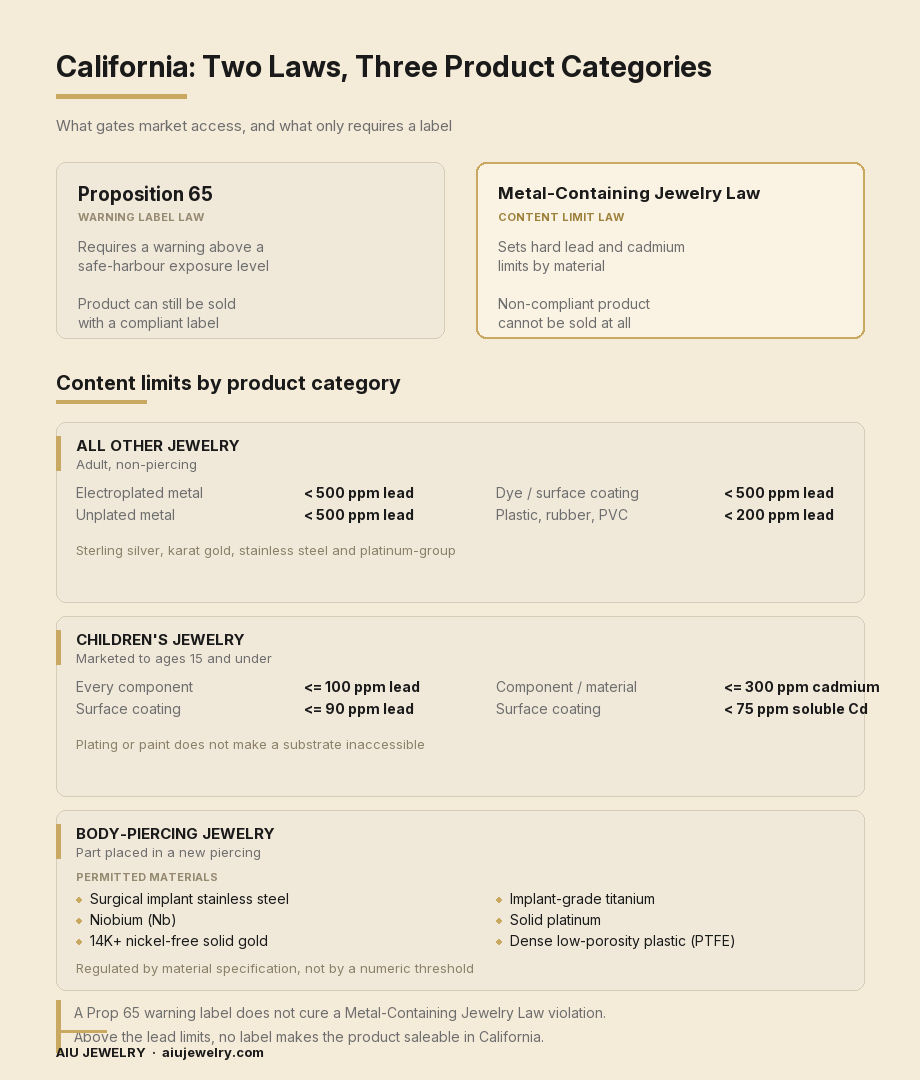
California‘s Metal-Containing Jewelry Law, as amended by SB 647 with levels effective 1 June 2020, sets different requirements for three product categories.
All other jewelry (adult, non-piercing)
The law works by listing permitted materials rather than only setting a number. Jewelry must be made entirely from materials on the approved list, which includes:
- Sterling silver, karat gold, stainless or surgical steel, platinum, palladium, rhodium and related metals
- Natural or cultured pearls; cut and polished gemstones (with a named exclusion list); glass, ceramic and crystal components including cubic zirconia
- Electroplated metal below 0.05% (500 ppm) lead by weight
- Unplated metal not otherwise listed, below 0.05% (500 ppm) lead
- Dyes and surface coatings below 0.05% (500 ppm) lead; plastics and PVC below 0.02% (200 ppm) lead
Sterling silver appears by name on California‘s approved materials list. For a 925 silver line, the compliance question shifts from the base metal to the plating, solder, dyes and any non-listed components in the build.
Children‘s jewelry (marketed to ages 15 and under)
Substantially stricter, and cadmium enters the picture:
- Every component: ≤ 0.01% (100 ppm) lead, excluding genuinely inaccessible parts
- Surface coating: ≤ 0.009% (90 ppm) lead
- Component or material: ≤ 0.03% (300 ppm) cadmium
- Surface coating: < 0.0075% (75 ppm) soluble cadmium
Plating, paint or coating does not make a substrate "inaccessible" under this law. The exclusion is narrow. It covers sealed or cased components only, and they must stay sealed through foreseeable use and abuse — including a child mouthing the item, and the item breaking.
Body-piercing jewelry
This category is regulated by material specification rather than by threshold. The part placed in a new piercing or mucous membrane must be made from surgical implant stainless steel, implant-grade titanium, niobium, solid 14 karat or higher nickel-free gold, solid platinum, or a dense low-porosity plastic such as PTFE with no intentionally added lead.
If you produce piercing jewelry for the Californian market, this list is the specification — a lead test result alone does not establish compliance.
How the Prop 65 Warning Rule Works
Proposition 65 requires a "clear and reasonable warning" before knowingly exposing anyone in California to a listed chemical above the applicable safe-harbour level. Lead and cadmium are both on the list.
Three points matter commercially:
- The warning is triggered by exposure, not by content alone. Two products with the same lead content can reach different conclusions depending on how the item is used and how much transfers to the user.
- A warning is not an admission that a product is unsafe, but over-warning has its own cost — many retail platforms and buyers treat a Prop 65 label as a negative signal, and some marketplaces restrict listings that carry one.
- Reformulation is often cheaper than warning. Industry settlements have driven reformulation commitments well below statutory thresholds — one settlement concerning cadmium in earrings capped content at 75 ppm. Where competitors reformulate, a warning label becomes a competitive disadvantage rather than a compliance solution.
The Enforcement Mechanism Europe Does Not Have
This is the structural difference that catches brands used to selling only into the EU.
Under European chemical regulation, enforcement sits with public authorities. Under Prop 65, any private individual or organisation acting in the public interest can enforce.
The mechanism is a 60-day notice of violation. It is served on the alleged violator, the state Attorney General and local prosecutors. If no public enforcer takes the case within those 60 days, the private party can sue directly.
The exposure is real and quantified:
- Civil penalties of up to $2,500 per day, per violation under Prop 65
- Separately, up to $2,500 per day per violation under the Metal-Containing Jewelry Law, with knowing and intentional violations carrying fines of $5,000 to $100,000, imprisonment up to a year, or both
- Falsifying a required compliance certificate: fines up to $50,000, imprisonment up to a year, or both
In practice most notices settle rather than litigate. But settlement costs plus defence costs land on the importer of record — usually your brand, not the overseas factory. That is why documentation quality is a commercial risk-transfer question, not a paperwork exercise.
Note: this article is general information about Californian requirements, not legal advice. Importers of record should confirm their own obligations with US counsel.
SB 647 Compliance: The Certificate California Actually Requires
The Metal-Containing Jewelry Law places an explicit certification duty on manufacturers and suppliers. The certificate must be given to the seller or displayed on the shipping container or packaging, and DTSC can demand supporting technical documentation within 28 days.
SB 647 specified what the certificate must contain. Eight elements, and a generic "we comply" letter meets none of them:
- A description of the jewelry detailed enough to match the certificate to the specific product
- Citation of each rule or standard being certified against
- Name, full mailing address and telephone of the certifying manufacturer or supplier
- Contact details of the person holding the test records
- Month and year of manufacture
- City, region and country of manufacture or final assembly
- Dates and locations of the certification testing
- Name, address and telephone of the third-party laboratory that performed the testing
Testing must use EPA Method 3050B, 3051A or 3052 for total digestion — the law names the methods, so a report using an unrelated method does not satisfy it.
What Your Importer of Record Will Ask You For
Work backwards from the three questions a US customs broker or retail compliance team puts to an importer, and you get a practical checklist for any supplier — including us.
"Which specific material line is this report for?"
A report covering stainless steel proves nothing about a silver piece. Our 316L line carries dedicated Prop 65 lead and cadmium testing under SGS report SZHH01824690. Our 925 sterling silver line runs on separate continuing third-party testing covering lead and cadmium content — and sterling silver is on California‘s approved materials list in its own right, which changes what has to be proven.
"Does the certificate name my product, or is it a form letter?"
Because California mandates eight content elements, a standing letter fails on arrival. We issue project-specific certification naming your product, your manufacture dates and the testing laboratory.
"How do I know the next batch matches the tested one?"
Component-level testing continuity is one of the inputs behind our 0.03% final-inspection defect rate (based on internal QC records over the past 12 months; an internal quality metric, not a legally binding guarantee). Report formats are visible on our certification and honor page.
On report validity: lab reports apply only to the samples submitted, and are representative of ongoing production batches rather than permanently valid certificates. Switching alloy sources, plating stacks, solder or component suppliers requires fresh testing. Always request the latest valid copies for your specific order before shipment.
Frequently Asked Questions
Does a Prop 65 warning label make my product compliant?
Only for Prop 65 purposes, and only if the warning is clear, reasonable and correctly delivered. It does nothing for the Metal-Containing Jewelry Law. If your product exceeds the lead limits in that statute, it cannot be sold in California regardless of labelling.
Is a REACH report enough for the Californian market?
No. The thresholds and test methods differ. REACH Entry 63 restricts lead to 0.05% by weight per individual part, which happens to align numerically with California‘s general jewelry limit, but Californian children‘s jewelry sits far lower at 100 ppm, cadmium rules differ, and California names specific EPA digestion methods. Our separate breakdown of REACH Annex XVII entries 23, 27 and 63 covers the European side.
Does this apply if I only sell online and ship into California?
Yes. The Metal-Containing Jewelry Law explicitly names online stores and websites, mail order companies and businesses of all sizes among those subject to it. Physical presence in the state is not the test.
What should I ask a supplier before shipping to the US?
Ask for the certificate content, not just a pass statement: which specific products it covers, which laboratory tested them, on what dates, and which EPA method was used. A supplier who cannot produce those eight elements cannot support your importer of record. For the wider set of pre-contract questions, see our 7-step supplier vetting checklist.
Shipping into California and unsure where you stand? Send us your product category and material list and we will map it against both Californian regimes — see below.
California is one state in one market. If your range also ships to the EU or the UK, our market-by-market guide to jewelry compliance evidence shows what changes at each destination — and what you can reuse.
.png)
Need your range mapped against Californian requirements? Send us your product category (adult / children‘s / body-piercing) and your full material list — we will identify which limits apply, which of our existing reports cover your components, and what a compliant certificate for your shipment needs to contain. Response within 24 hours, under NDA. No commitment required.
 anya907888