



Does RoHS Apply to Jewelry? Understanding Directive 2011/65/EU for Fashion Accessories
.jpg)
Every so often a buyer forwards a retailer questionnaire with "RoHS certificate" listed alongside REACH and nickel release, and asks the factory to produce one. For most jewelry, that request is asking for the wrong document — and paying for a test that proves nothing about the product‘s actual compliance position.
Key takeaways
- RoHS regulates electrical and electronic equipment, not jewelry. The test is whether the article has an electrical or electronic component — not what category it is sold in.
- A plain silver ring is outside RoHS scope. No current, no circuit, no scope. REACH Annex XVII is the regulation that actually governs it.
- A light-up pendant is inside scope. Add an LED, a coin cell or a charging port and the same piece becomes EEE.
- Ten substances are restricted — the familiar four metals, two brominated flame retardants, and four phthalates added by Directive (EU) 2015/863.
- Buying an unnecessary RoHS report costs money and proves nothing. Worse, it can create a false sense of coverage while the real obligation goes unmet.
Jump to: what RoHS regulates · the one-question scope test · the ten substances · when jewelry does need it · RoHS vs REACH · how we handle it · FAQ
What RoHS Actually Regulates
RoHS is Directive 2011/65/EU on the restriction of hazardous substances in electrical and electronic equipment. Its subject is EEE — the equipment itself — and its purpose is to keep hazardous substances out of the electronics waste stream so that end-of-life products can be recycled more safely.
The European Commission states the principle in one line:
"All products with an electrical and electronic component, unless specifically excluded, have to comply with these restrictions."
Read that carefully, because it is the whole answer. The trigger is the presence of an electrical or electronic component. It is not the product category, not the retail channel, and not whether the item is worn on the body.
The One-Question Scope Test
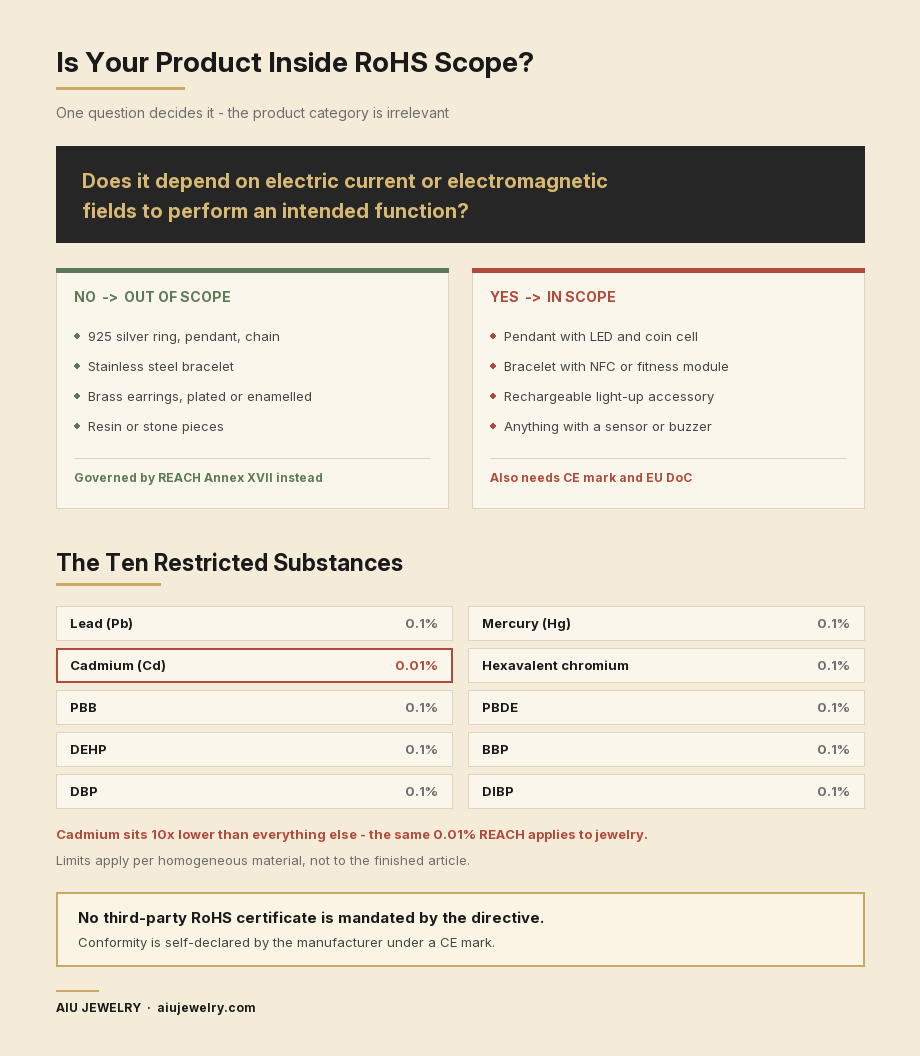
Before commissioning any test, ask one question about the finished article:
Does it depend on electric current or electromagnetic fields to perform at least one of its intended functions?
If the answer is no, the piece is not EEE and RoHS does not apply to it.
| Product | Electrical function? | RoHS position |
|---|---|---|
| 925 silver ring, pendant, chain | No | Out of scope — governed by REACH |
| Stainless steel bracelet with stones | No | Out of scope |
| Brass earrings, plated or enamelled | No | Out of scope |
| Pendant with an LED and coin cell | Yes | In scope — RoHS applies |
| Bracelet with a fitness or NFC module | Yes | In scope |
| Rechargeable light-up hair accessory | Yes | In scope |
The same design can sit on either side of the line depending on one component. A plain resin pendant is out of scope; the identical pendant with an LED embedded in it is EEE, and it needs a CE mark, a Declaration of Conformity and RoHS compliance behind it.
The Ten Restricted Substances
RoHS originally restricted six substances. Directive (EU) 2015/863 — often called RoHS 3 — added four phthalates, bringing the current list to ten:
- Lead (Pb) — 0.1%
- Mercury (Hg) — 0.1%
- Cadmium (Cd) — 0.01%
- Hexavalent chromium (Cr VI) — 0.1%
- Polybrominated biphenyls (PBB) — 0.1%
- Polybrominated diphenyl ethers (PBDE) — 0.1%
- DEHP · BBP · DBP · DIBP — 0.1% each, added by (EU) 2015/863
Two points matter for anyone building light-up or smart accessories.
First, cadmium sits ten times lower than everything else — 0.01% against 0.1%. That is the same threshold REACH Entry 23 applies to jewelry, so a supply chain already controlled for REACH cadmium is usually in a reasonable starting position.
Second, limits apply per homogeneous material, not to the finished article. A homogeneous material is one that cannot be mechanically separated into different materials — a single solder joint, one plating layer, the plastic body of a connector. Averaging a compliant chain against a non-compliant solder point does not produce a compliant product.
When Jewelry Genuinely Needs RoHS
The category is small but growing. Treat RoHS as live if your design includes any of the following:
- Illumination — LEDs, fibre optics with a driver, electroluminescent wire.
- A power source — coin cells, rechargeable cells, USB or wireless charging.
- Electronics — NFC or RFID tags, Bluetooth modules, sensors, timing circuits.
- Sound or motion — buzzers, vibration motors, anything with a moving powered part.
Where scope is triggered, RoHS is rarely the only new obligation. The article typically also needs a CE mark, an EU Declaration of Conformity, and — where cells are fitted — battery regulation compliance. Radio modules bring the Radio Equipment Directive into play as well.
This is why the honest answer to "can you add a small LED?" is not simply yes. Adding one component moves the product into a different regulatory regime, and the compliance cost is usually larger than the component cost.
RoHS and REACH Are Not Alternatives
These two are frequently treated as interchangeable proof of "chemical compliance". They are not, and understanding the split prevents both over-testing and under-testing.
| RoHS 2011/65/EU | REACH Annex XVII | |
|---|---|---|
| Applies to | Electrical and electronic equipment | Substances in articles generally, including jewelry |
| Covers plain jewelry? | No | Yes |
| Cadmium limit | 0.01% per homogeneous material | 0.01% (Entry 23) |
| Nickel release | Not addressed | Entry 27 — 0.5 μg/cm²/week |
| Proof format | CE mark + EU Declaration of Conformity | Test reports and certificates |
For a conventional jewelry line, REACH is the regulation that governs you and RoHS is not. If you are unclear which entries apply, we cover them in our breakdown of REACH Annex XVII entries 23, 27 and 63.
Note also the direction of proof. RoHS conformity is self-declared by the manufacturer under a CE mark — there is no third-party RoHS certificate mandated by the directive. Laboratory reports support that declaration; they do not replace it. The distinction between a laboratory conclusion and a supplier‘s own declaration is worth understanding here, and we set it out in what a certificate of compliance actually proves.
How We Handle RoHS Requests
At AIU Jewelry, most RoHS requests we receive concern products that are out of scope. Our answer in those cases is to say so.
"Our retailer‘s form asks for RoHS. What do we send?"
If the range is conventional jewelry, the accurate response to the retailer is that RoHS does not apply, together with the REACH documentation that does. Most compliance teams accept this immediately, because the questionnaire is a generic multi-category template rather than a considered request. Sending a RoHS report for a plain silver ring signals that nobody on the supply side understood the question.
"We still want one on file."
Some buyers need it regardless — a marketplace upload form with a mandatory field, or an internal policy that predates any analysis. We hold SGS RoHS report CANEC2100348201 (certificate reference 2426K) and can supply it. We will tell you plainly that it is not the document your product‘s compliance actually rests on.
"We‘re adding an LED to a pendant."
Now the conversation changes. That product is EEE, and the work extends past RoHS to CE marking, an EU Declaration of Conformity and battery compliance. We will map what applies before sampling, so the compliance cost is visible while the design can still change.
Underpinning all of this is our documented process control: a 0.03% final-inspection defect rate (based on internal QC records over the past 12 months; an internal quality metric, not independently audited and not a legally binding guarantee). Report formats are visible on our certification and honor page.
On report validity: lab reports and the certificates derived from them apply only to the samples submitted, and are representative of ongoing production batches rather than permanently valid documents. Switching alloy sources, plating stacks, solder or component suppliers requires fresh testing. Always request the latest valid copies for your specific order before shipment.
Note: this article is general information about EU requirements, not legal advice. Directive scope and exemptions are revised periodically — verify the current text before relying on any figure. Manufacturers and importers should confirm their own obligations with qualified counsel.
Frequently Asked Questions
Our retailer‘s questionnaire lists RoHS. Do we have to comply?
Only if the product is electrical or electronic equipment. For conventional jewelry it is not, and the correct reply is to explain the scope position and provide the REACH documentation instead. Generic supplier questionnaires are usually written to cover many categories at once, and a well-reasoned explanation is normally accepted.
Is there such a thing as a RoHS certificate?
Not as a mandatory instrument. RoHS conformity is declared by the manufacturer through CE marking and an EU Declaration of Conformity. Laboratories issue test reports and, commercially, documents titled "RoHS certificate" — these support a declaration but are not required by the directive itself.
Does RoHS cover nickel release?
No. Nickel release in skin-contact articles is REACH Annex XVII Entry 27, an entirely separate regime with a different measurement method. A RoHS report tells a buyer nothing about whether an item is safe for prolonged skin contact.
We sell light-up jewelry. What do we need beyond RoHS?
Expect CE marking with an EU Declaration of Conformity, RoHS compliance, and battery regulation obligations where cells are fitted. Wireless functions add the Radio Equipment Directive. Plan the compliance route before tooling, because retrofitting it after production is considerably more expensive.
Does the UK have its own version?
Yes. Great Britain operates the UK RoHS Regulations with UKCA marking; Northern Ireland continues to follow the EU directive under the Windsor Framework. The restricted substances currently mirror the EU list, though the two regimes can diverge over time.
RoHS is usually the wrong request for conventional jewelry. To see what the right ones are — market by market, with the mandatory items separated from the optional — read which jewelry test report actually matters.
.png)
Not sure whether a piece in your range falls inside RoHS scope? Send us the construction — materials, components and any electrical parts — and we will tell you which regulations actually apply, which documents you need, and which requests on your retailer‘s questionnaire you can decline with a reasoned answer. Response within 24 hours, under NDA.
Last updated: August 2026. Reviewed by the AIU Jewelry compliance team. Scope and substance list verified against European Commission published guidance at time of writing.
 anya907888